FIDO
A smart pen system designed to transform the way detectives capture and act on evidence during the critical first 48 hours of a homicide investigation.
The Case
for Change
Homicide investigations fail not for lack of effort, but for lack of systems that can keep pace with the speed of field work.
This project addresses the inefficiencies caused by manual data management and fragmented case systems. The goal was to develop intelligent tools using AI and visualization to help detectives organize information and collaborate more effectively.
Ultimately this should lead to faster case resolution and improved closure rates in homicide units stretched beyond capacity.
The critical window in which case-solving probability begins to drop sharply.
Investigative data standards FIDO draws on through global enterprise deployments.
Average time detectives spend on transcription versus active investigation work.
Defining the Core Challenge
Before any solution could be designed the team needed to understand exactly where the friction lived in a detective's daily workflow.
How can we help detectives capture and analyze information instantly, giving them the edge in the critical first 48 hours of an investigation?
Detectives struggle to convert handwritten notes, sketches, and audio into clean digital reports. This process is slow and creates a gap between field work and documentation.
Impact / Avg 2.3 hours per case lostTeams spend hours manually reviewing audio and body camera footage without intelligent summarization or flagging.
Impact / Up to 40% footage never reviewedMaintaining data flows between labs, facilities, officers, and district attorneys is fragmented and error-prone.
Impact / Avg 14 day delay in lab handoffDetectives lack a unified system to manage reports, findings, and evidence in one cohesive place.
Impact / Up to 7 separate tools per caseGathering the Evidence
Interviews surfaced four key issues in current crime reporting. Tap any source badge to read the citation.
Deep User Understanding Is Key
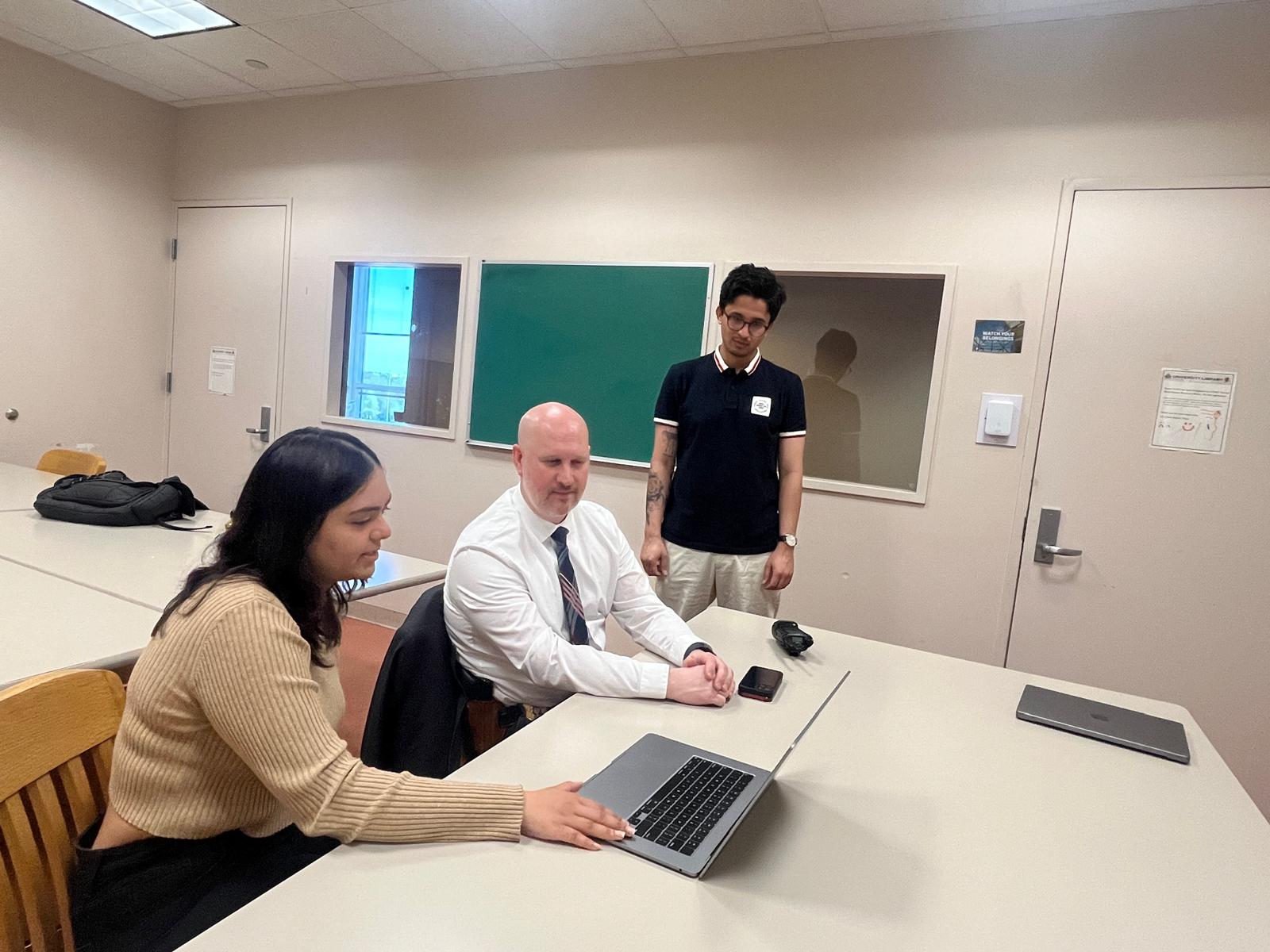
This project leveraged diverse research methods including direct interviews with stakeholders and detectives, recorded interviews from other research groups, and academic papers to thoroughly understand the workflow and pain points.
Significant Operational Inefficiencies Exist
Detectives currently face numerous pain points including manual reporting, time-consuming audio and video review, poor coordination due to siloed data, and overall information overload.
Untapped Potential for AI and Data Integration
There are clear opportunities to streamline field reporting, enhance investigative thinking with intuitive AI, and centralize and visualize case data.
Existing Solutions Fall Short on Integration
Current tools including i2 Analyst Notebook, Cellebrite, and Palantir Gotham face challenges with data integration complexity, privacy concerns, and lack of user-centric design.


Detectives struggle converting handwritten notes, sketches, and audio into digital formats. An intelligent capture solution eliminates this bottleneck without forcing a workflow change.
Detective instinct can be augmented significantly by AI-driven pattern recognition and contextual entity linking that surfaces connections invisible to the human eye under pressure.
Fragmented systems and data silos prevent detectives from easily accessing and analyzing their own case information. A unified system transforms scattered inputs into investigative clarity.
Meet Detective Cruz
DETECTIVE CRUZ
Homicide Investigator, IMPD
- ◆Heavy reliance on personal notes and a CAD dispatch system
- ◆Primarily works from printed case files and physical evidence boards
- ◆Coordinates with forensic labs via phone and email with no unified tracking
- ◆Spends significant evening hours catching up on transcription and reporting
A study by Michelle Wright, Manchester Metropolitan University, explores the mental process behind detective decision-making.
Detectives use a combination of intuitive and analytical thinking strategies. FIDO is designed to support both modes.
The Future of Forensics
A Digital Pen Narrative
This storyboard traces the current inefficient manual processes and shows exactly how the pen closes each gap from the very first 48 hours.
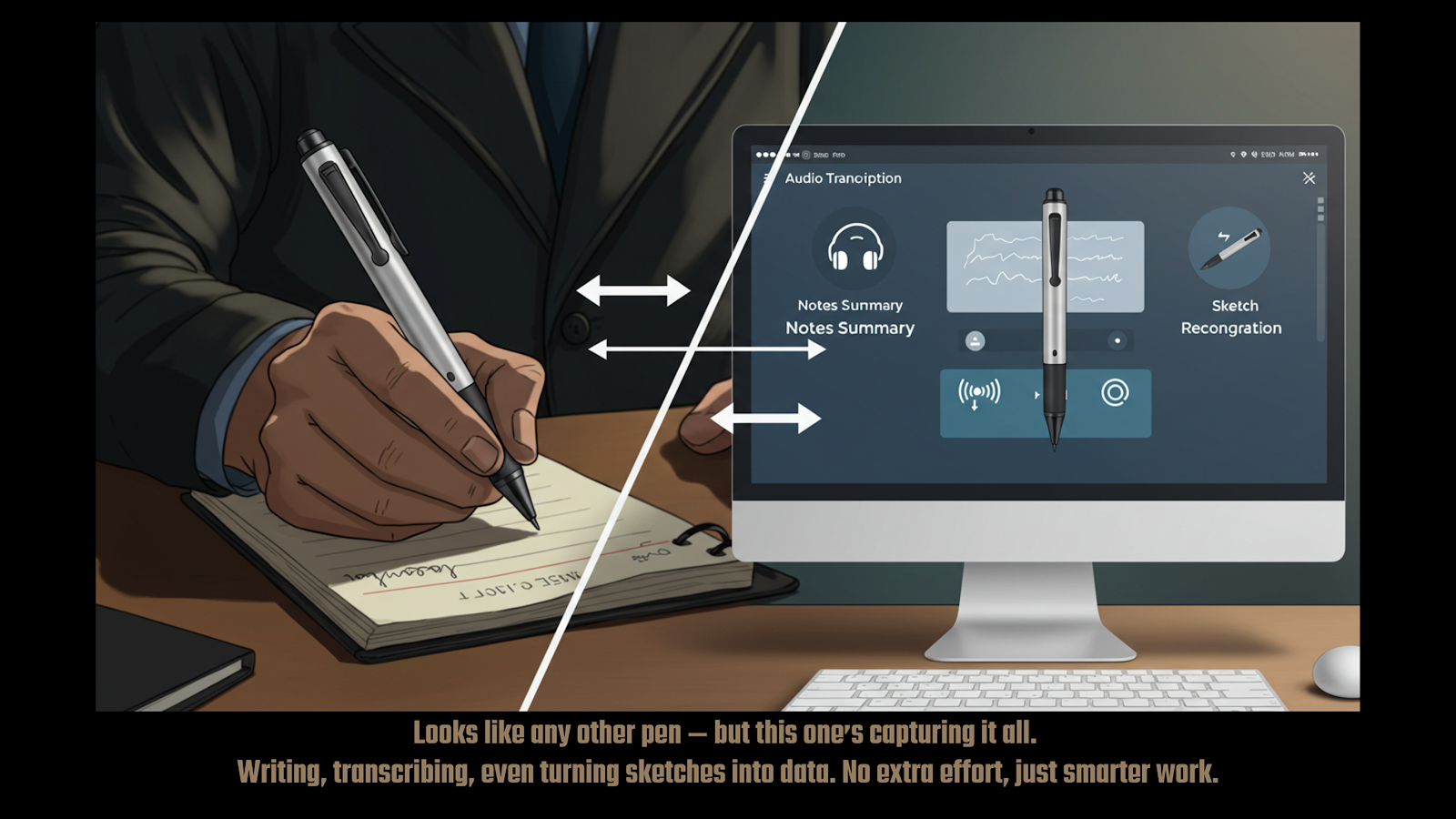
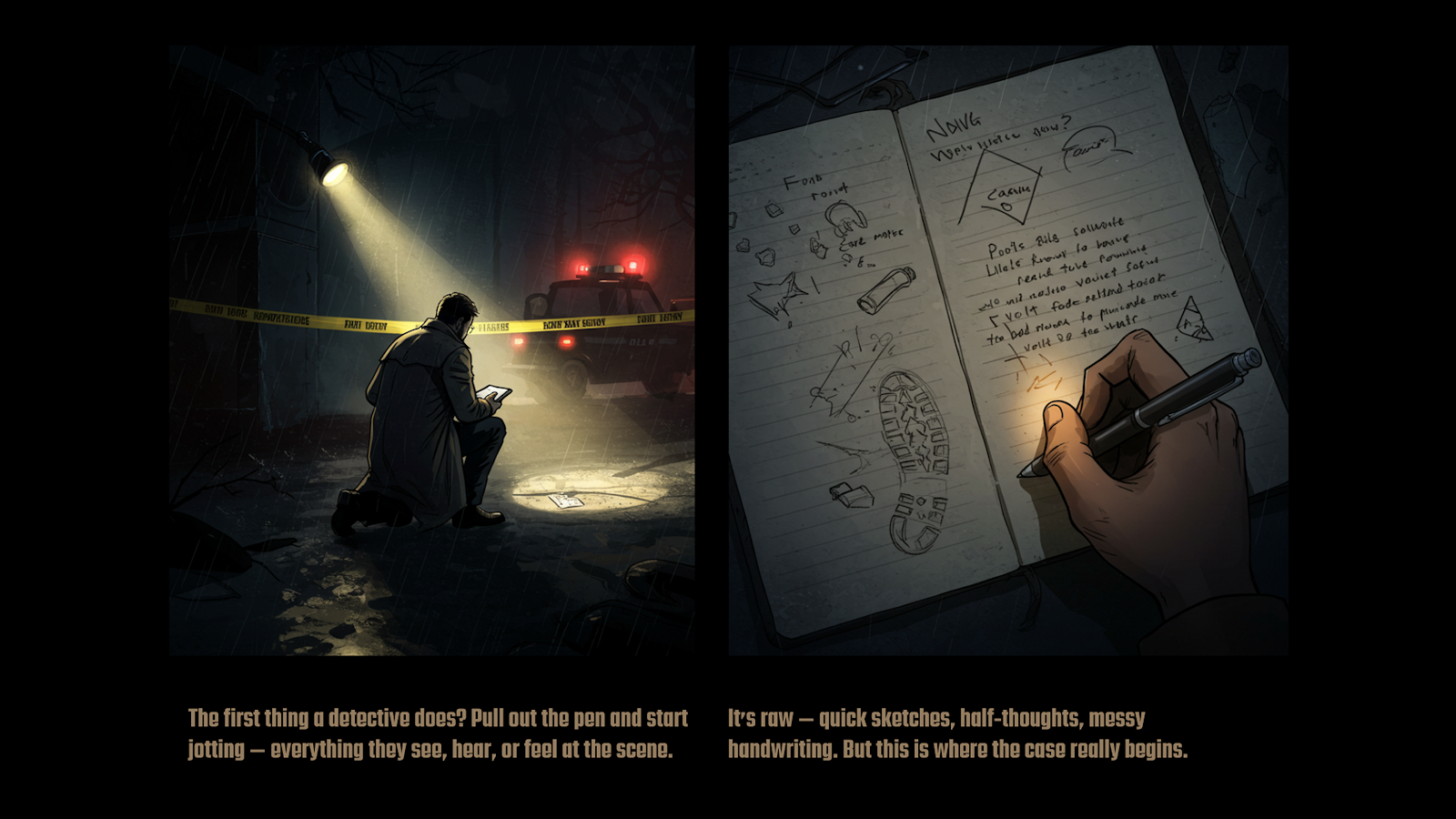
The first thing a detective does is pull out a pen and start writing. Everything they see, hear, and feel at the scene gets captured in fast, messy handwriting under pressure.
Those notes are quick sketches, half-formed thoughts, and messy handwriting. This is where the case really begins, but the current tools cannot keep pace.
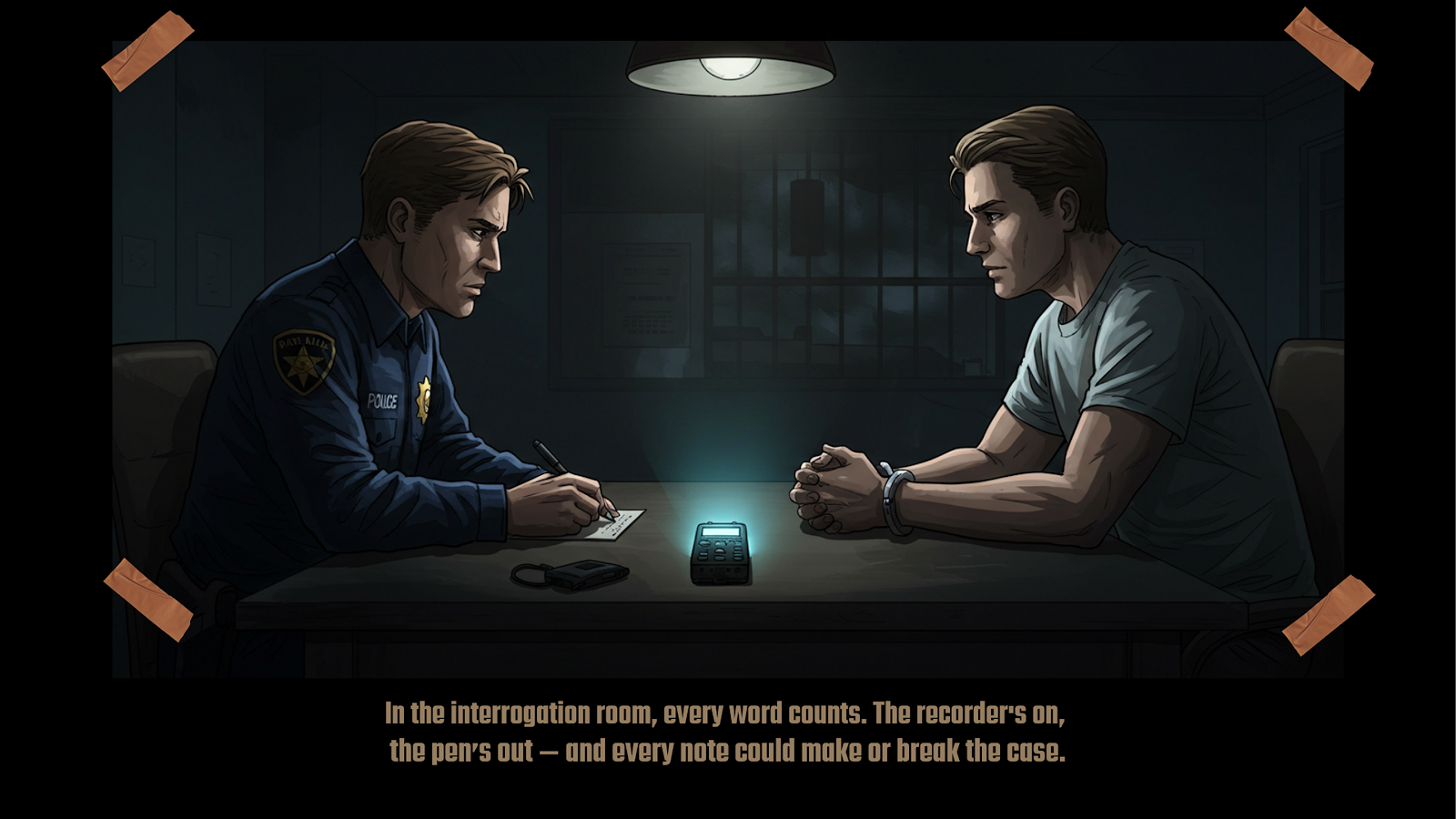
Every word counts in the interrogation room. The recorder is running but every note made or missed could determine the direction of the entire case.
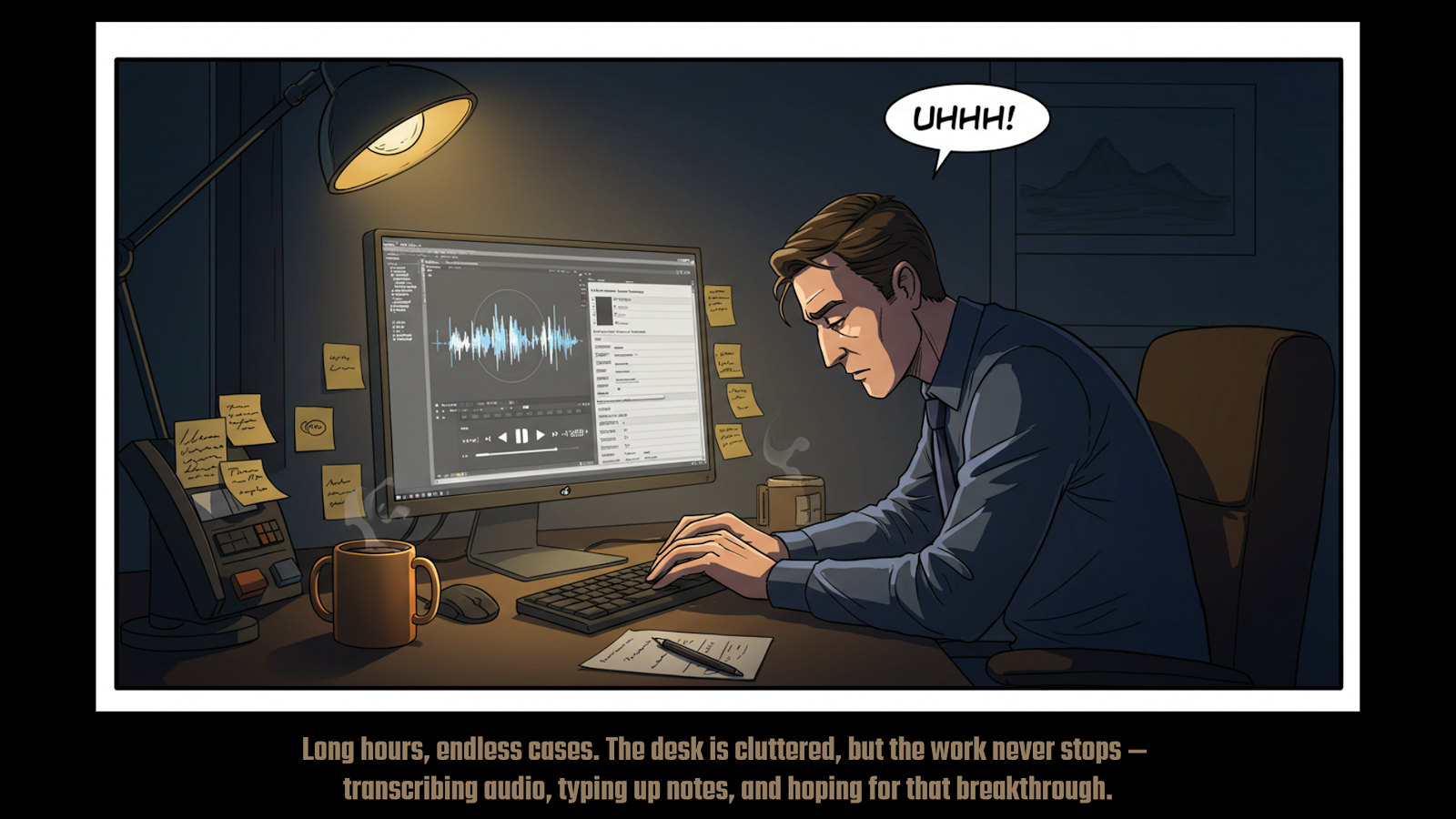
The desk is cluttered and the work never stops. Transcribing audio and typing notes consumes hours that could be spent investigating instead.
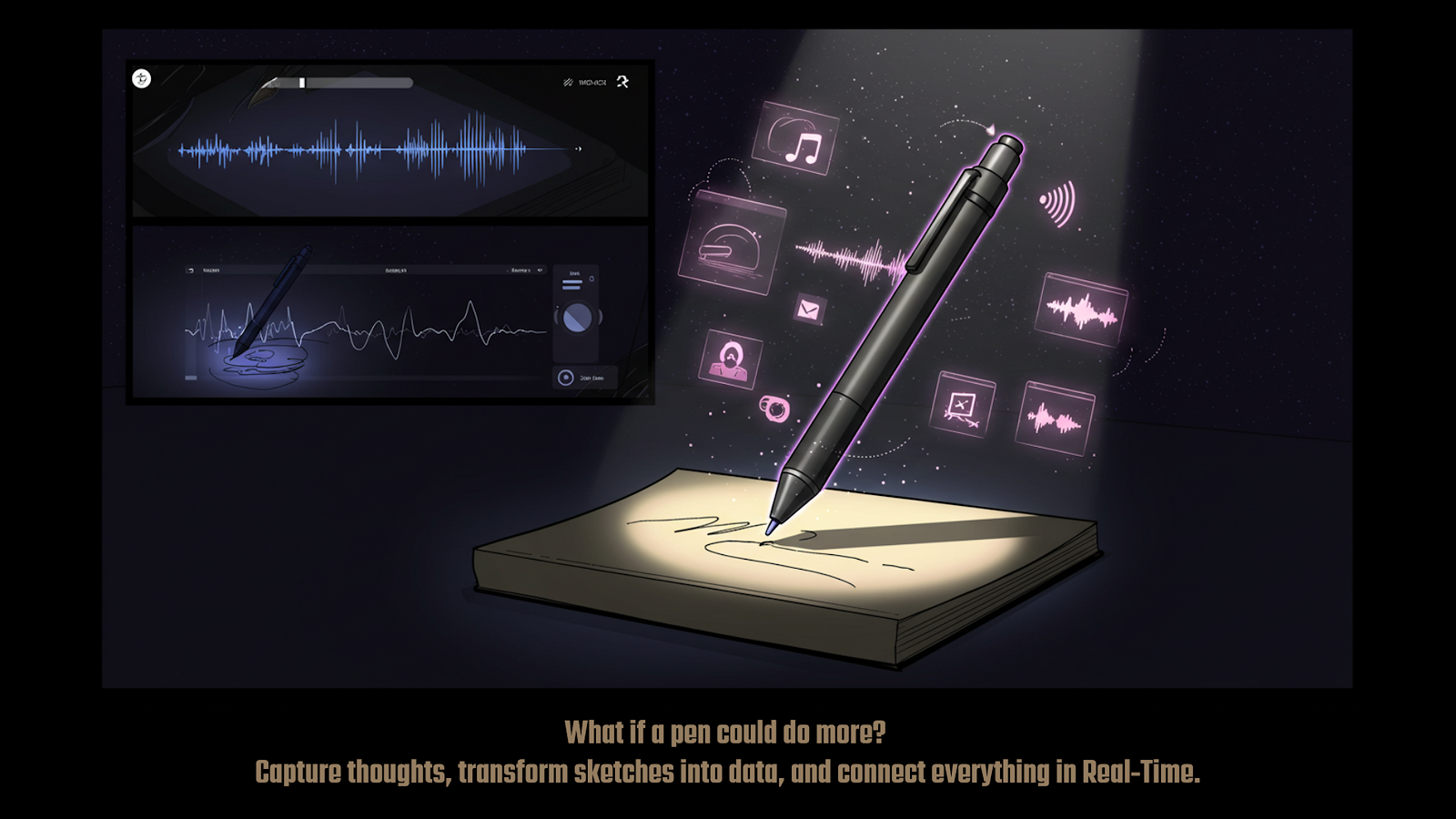
Capture thoughts instantly. Transform sketches into searchable data. Sync everything to the case in real time.
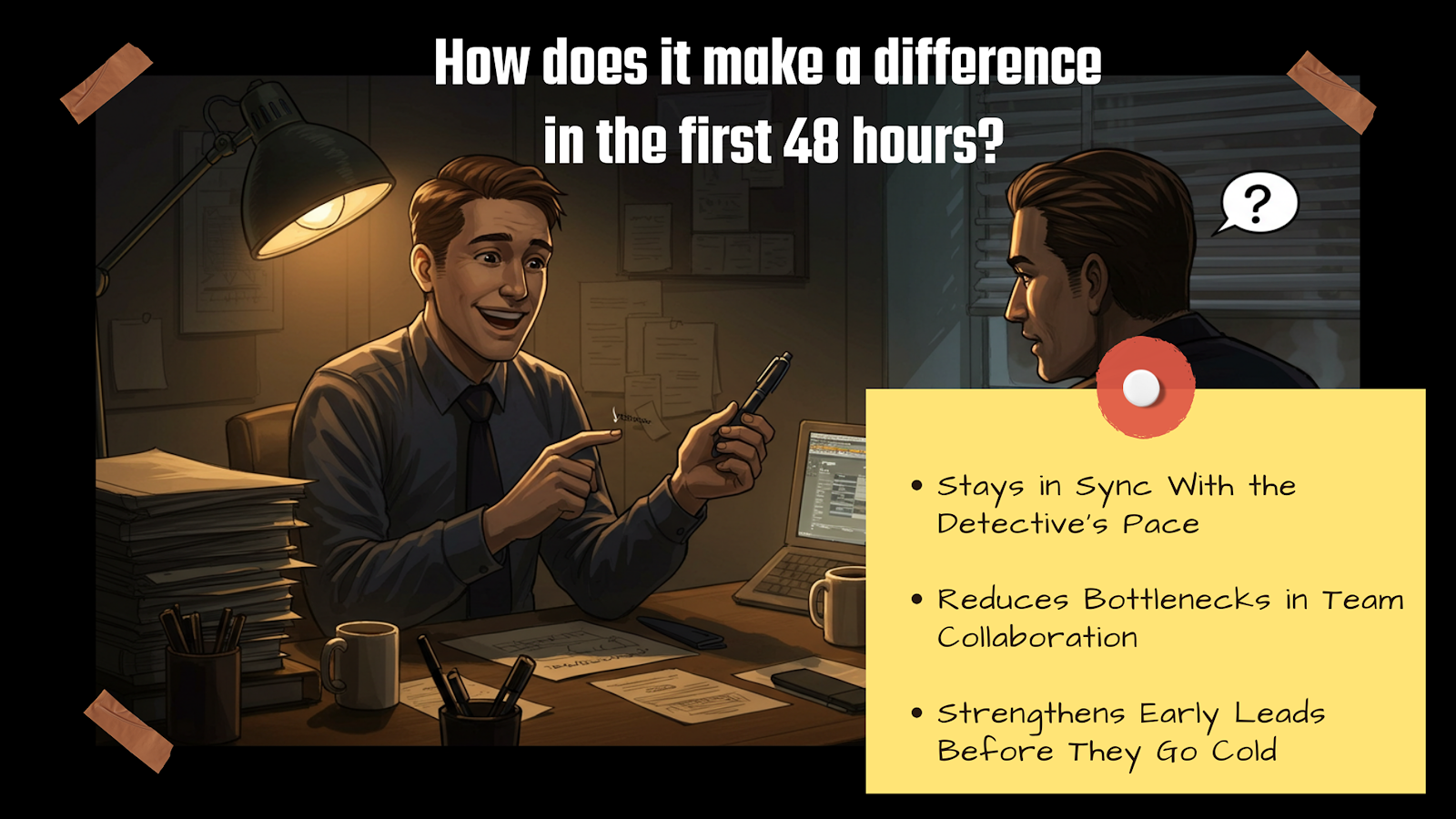
Stays in sync with the detective at every step. Reduces bottlenecks in team collaboration. Strengthens early leads before they go cold.
From Input to Intelligence
Four layers transform raw field input into structured investigative intelligence.
Input Layer
- ◆Smart pen with pressure sensors, motion tracking, and optional audio recording
- ◆Mobile companion app for syncing and supplemental data entry
- ◆Wireless magnetic charging dock with badge-ID pairing
Presenting FIDO
Named after the loyalty and precision of a trained tracking hound
FIDO is a smart pen system built specifically for the pace and pressure of homicide investigations. It combines on-device AI preprocessing with seamless cloud sync, linking evidence, audio, sketches, and annotations into structured data instantly.
Automating Data Capture
As detectives write, FIDO sensors capture every stroke and nuance, eliminating manual transcription later.
Instant Digitization
The pen preprocesses data electronically, segmenting strokes into words and symbols while sending to the cloud in real time.
Seamless Centralization
Processed data pushes directly into Case Management Systems, making it instantly searchable and organized.
Optional audio capture synced to handwritten notes via timestamp alignment
Every stroke recorded the moment it lands on the page with no latency
Personal pen profile tied to badge ID for chain of custody
Standard ballpoint ink so field notes remain legally admissible
From Sketch to Form
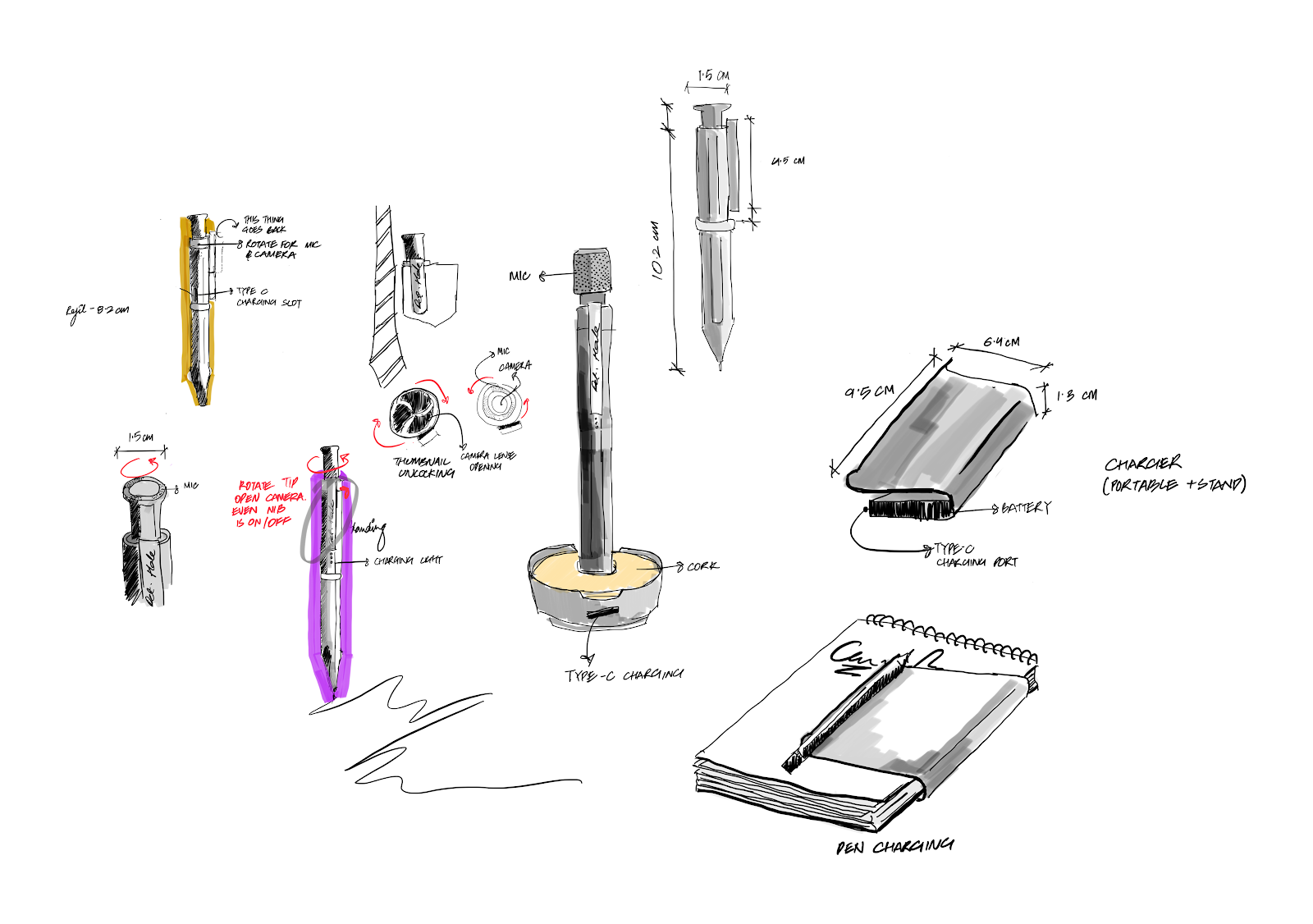
Multiple iterations of body shape, grip diameter, and clip mechanism were sketched and reviewed against detective hand poses observed in field interviews. The final form preserves the weight and balance of a standard police-issue pen.
From Concept to Tangible Form
The FIDO pen was 3D printed in aircraft-grade aluminum alloy mock-up to validate weight, balance, and grip ergonomics in the hands of working detectives.
The Charging Dock
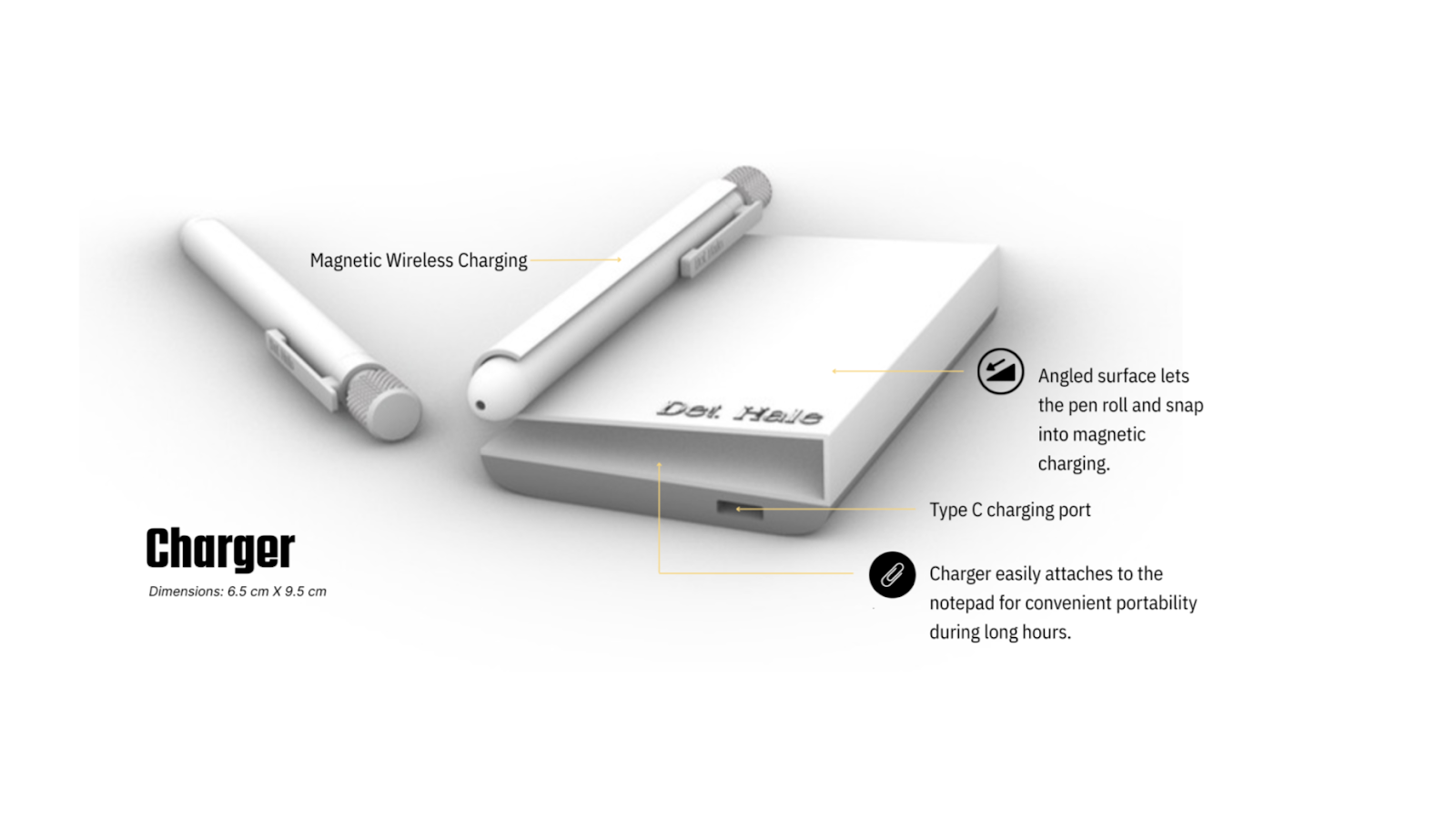
Dimensions 6.5 cm by 9.5 cm
The pen rolls along the angled surface and snaps into place automatically with no fumbling.
Universal connection that works with any standard police-issue cable or wall adapter.
The dock clips onto the back of any standard field notepad for convenient portability.
Each dock is laser-engraved with the assigned detective name to prevent mix-ups.
The Digital Companion
Twenty-two screens covering the full investigator workflow. Filter by group or tap any screen to inspect in detail.
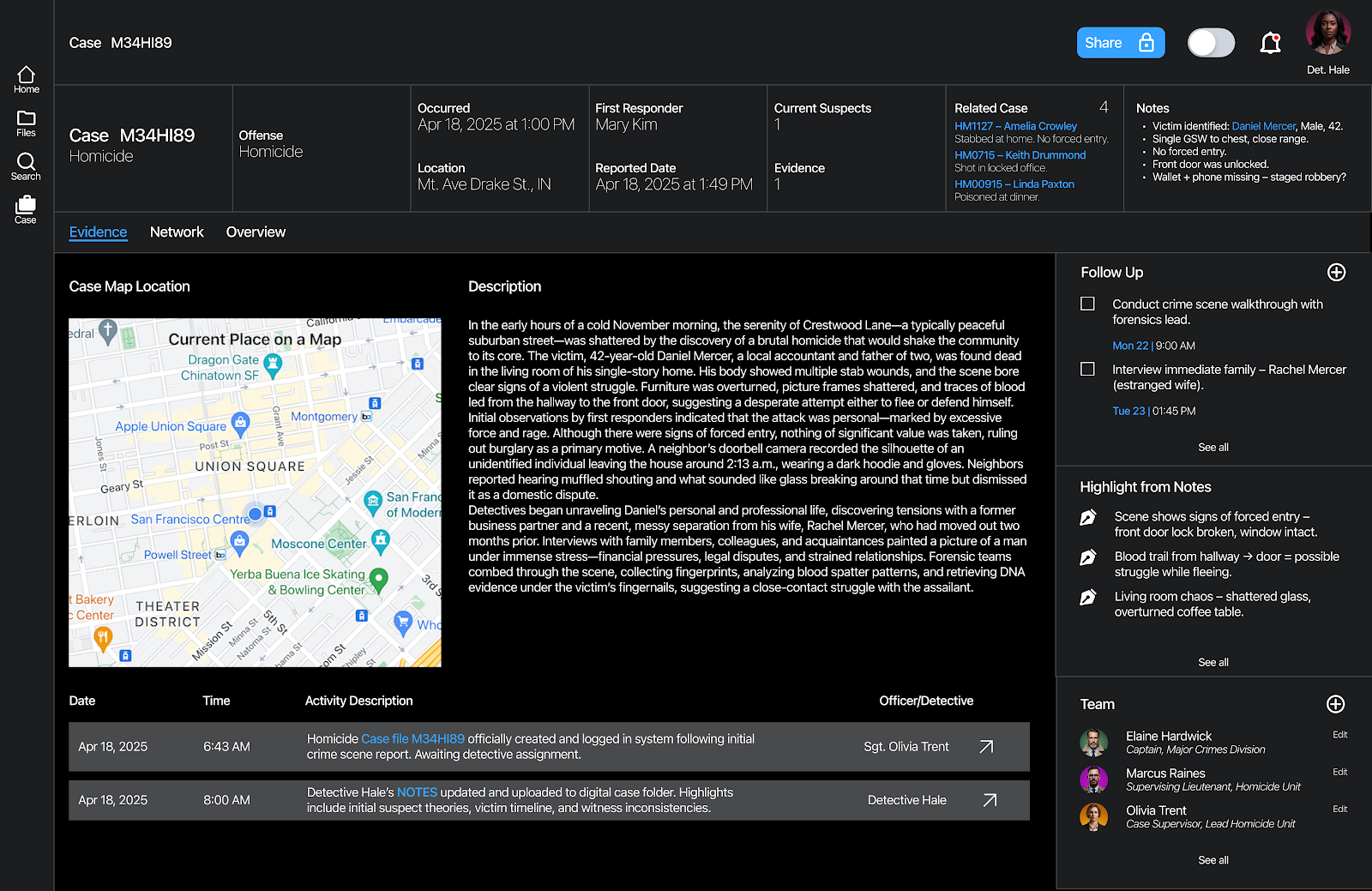
The home dashboard surfaces every active investigation at once. Cases inside the 48-hour window are flagged with a pulsing indicator.
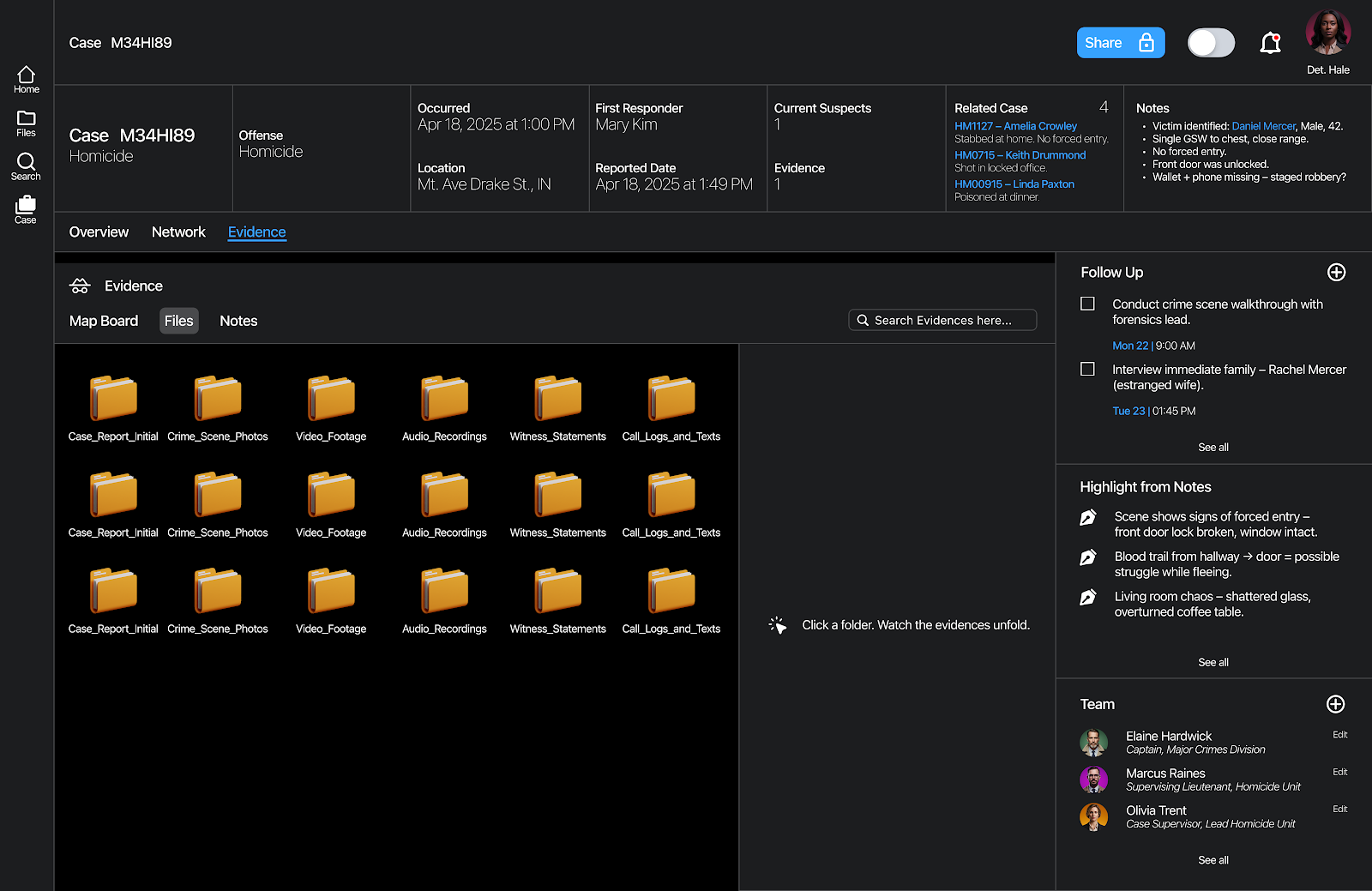
An expanded overview where the detective drills into specific case categories, filters by severity, and reviews aggregated statistics.
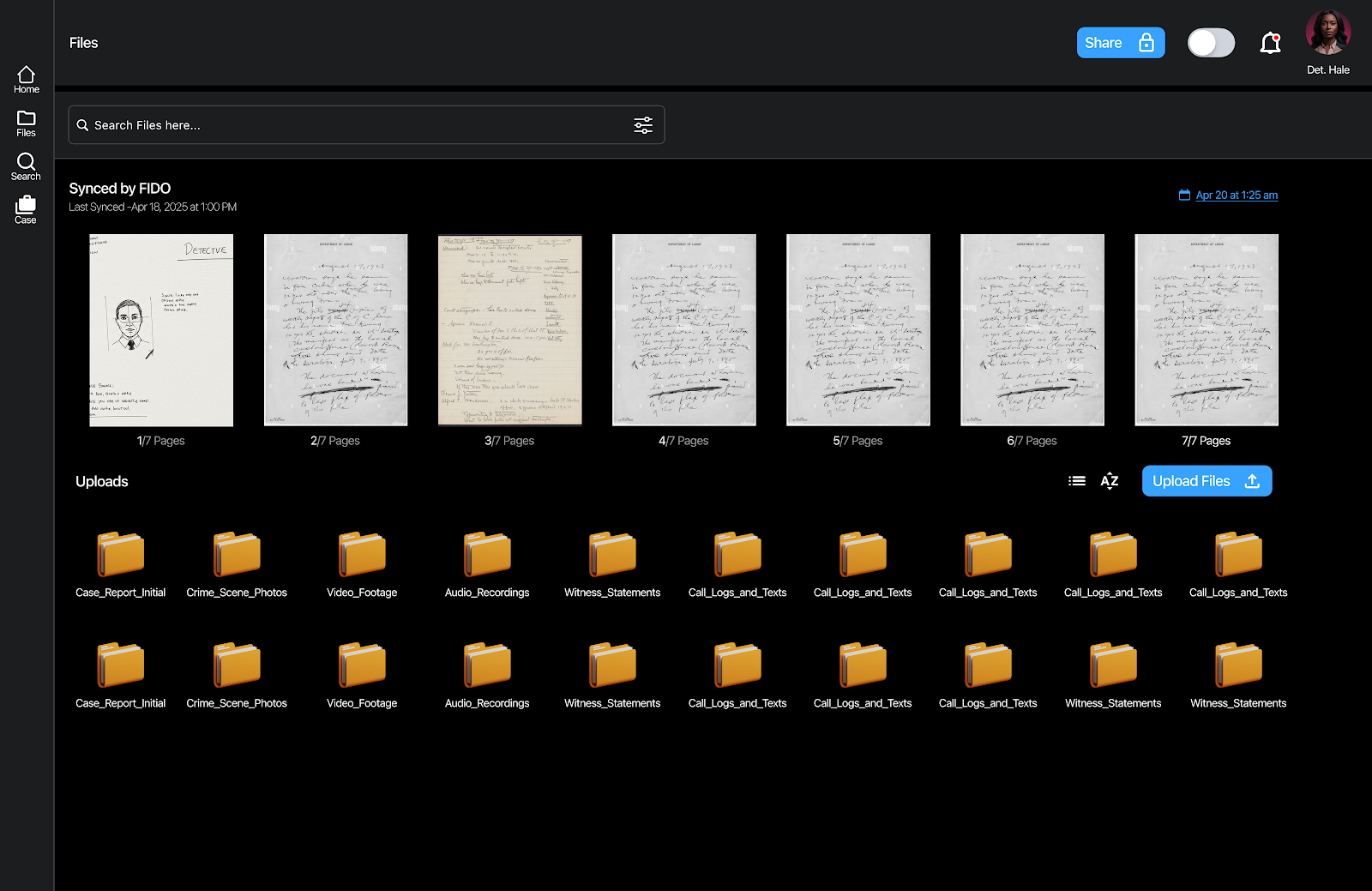
The central evidence repository for an active case. Every photograph, document, audio file, and field note organized in one view.
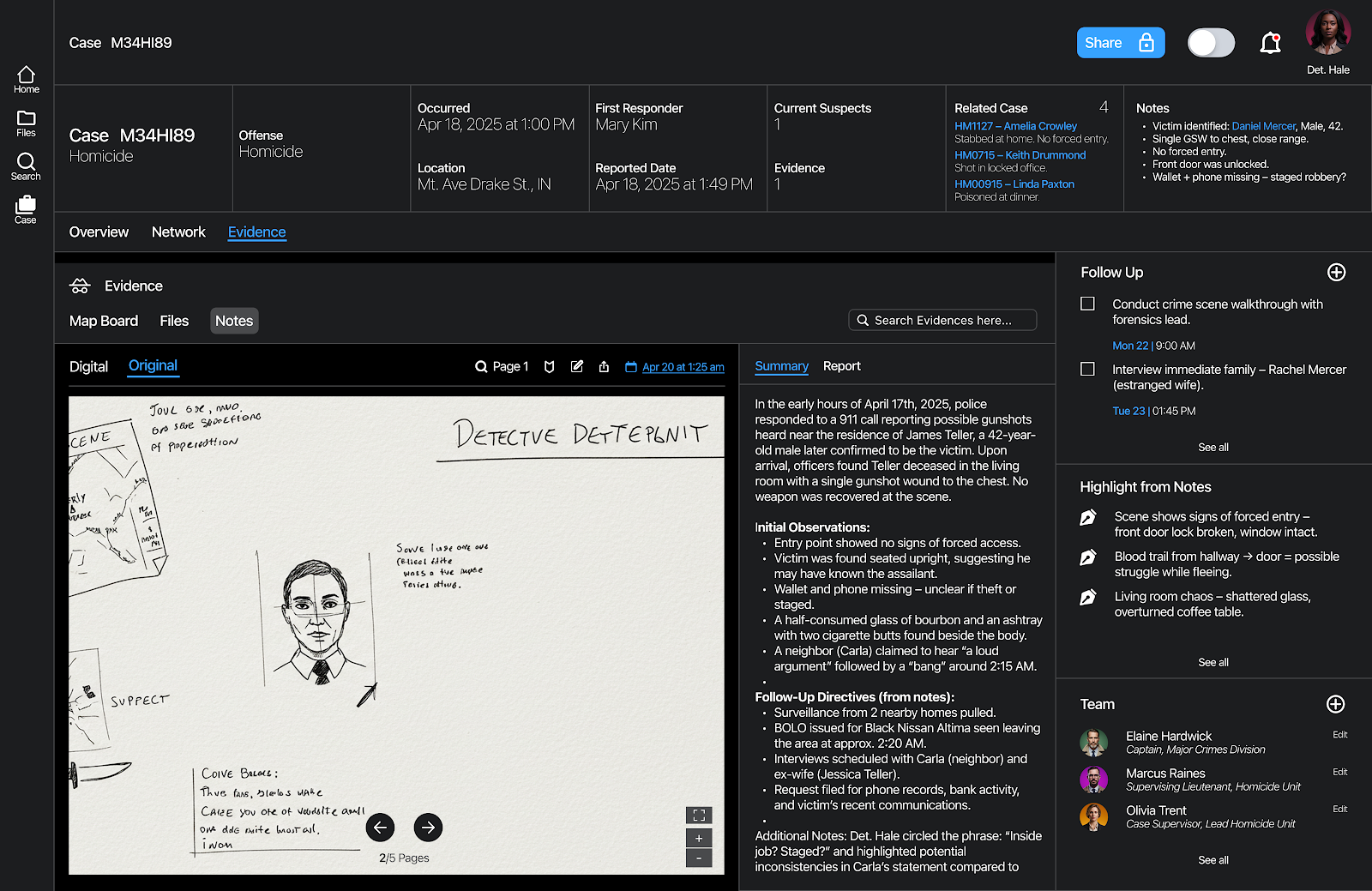
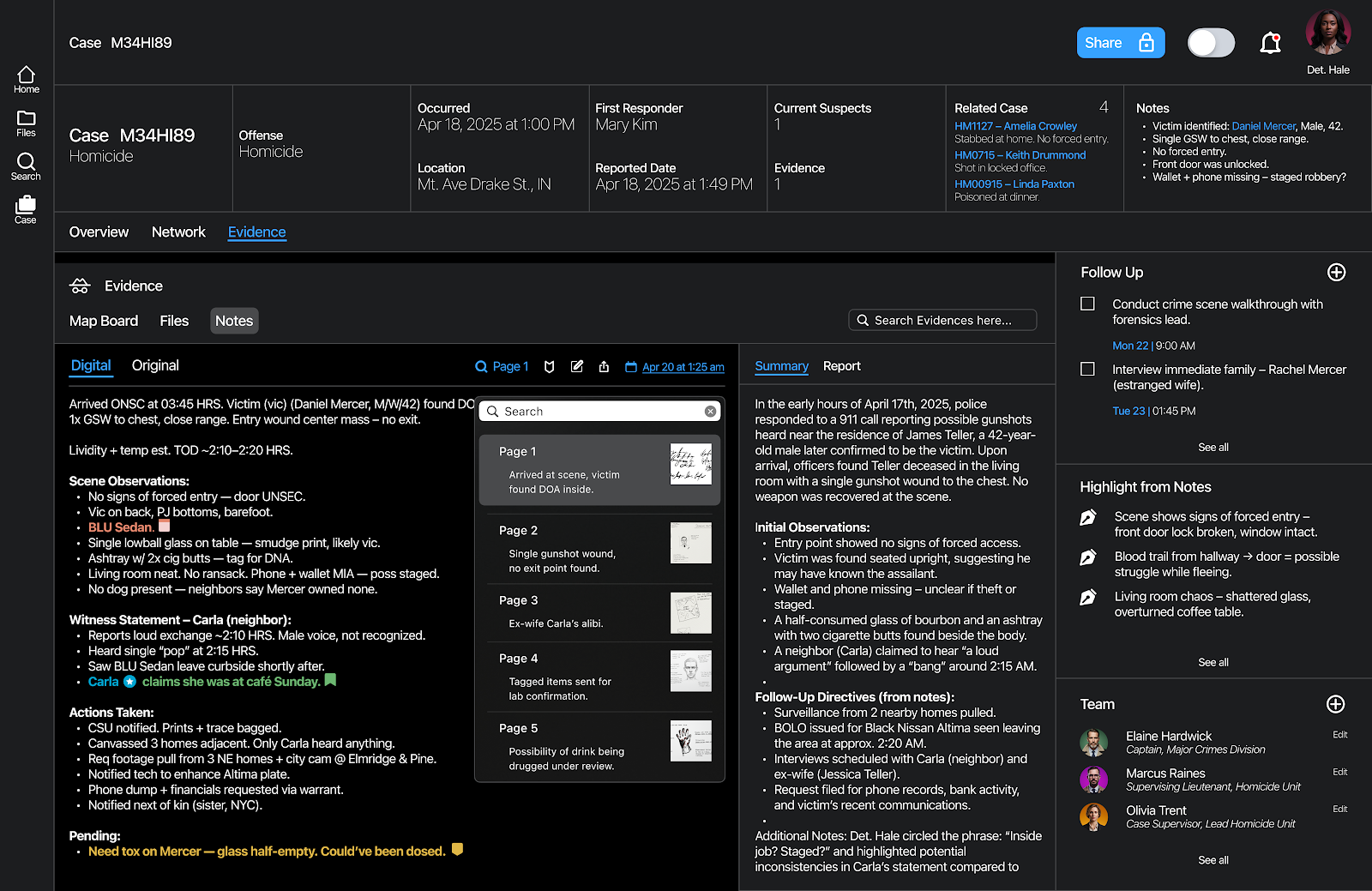
Handwritten field notes from the FIDO pen sit alongside their OCR transcription.
Cross-case search lets investigators find a name, location, or detail across every page they have ever written.
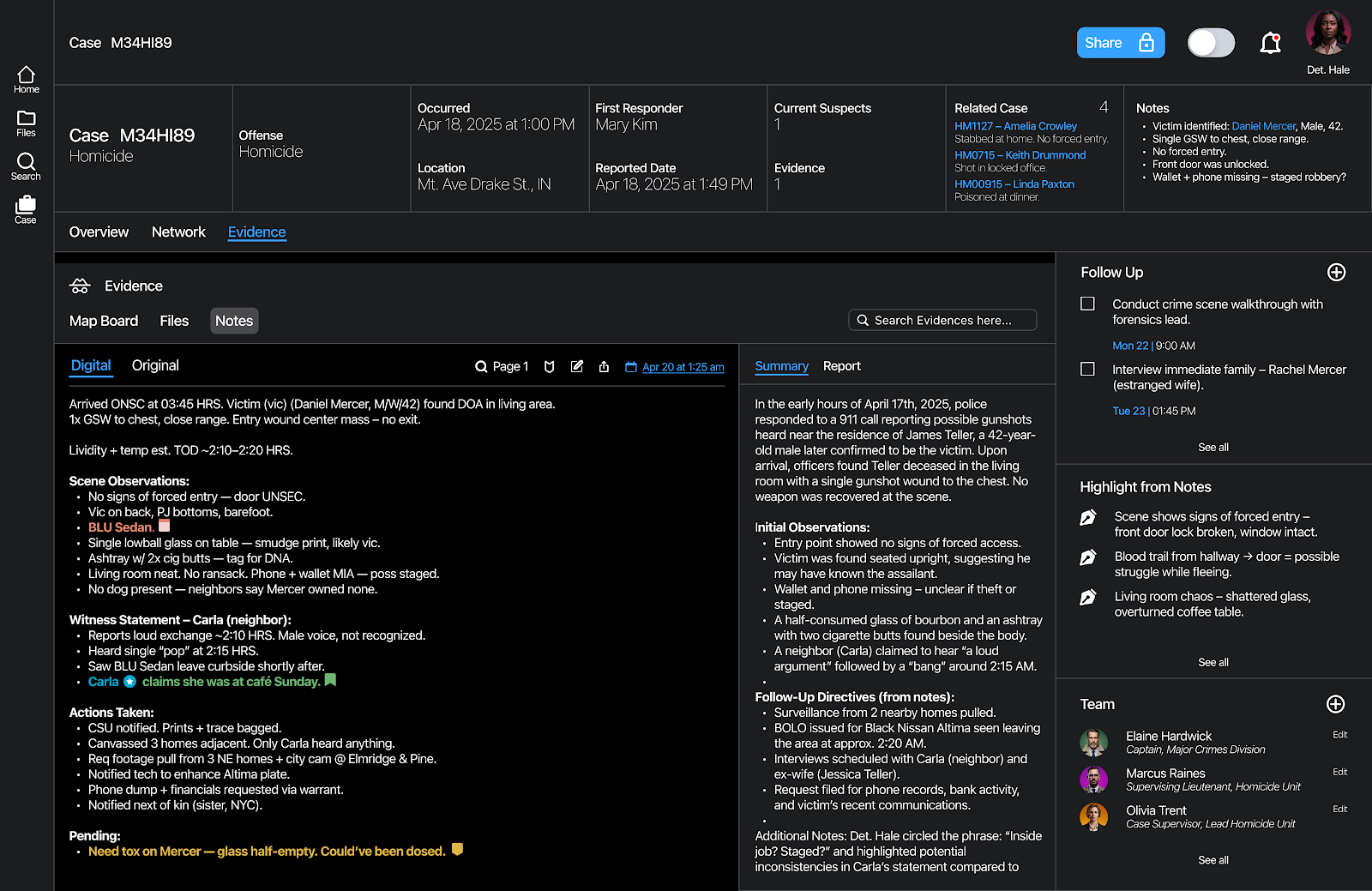
Pull-to-refresh syncs the latest pen captures and lab results from the field.
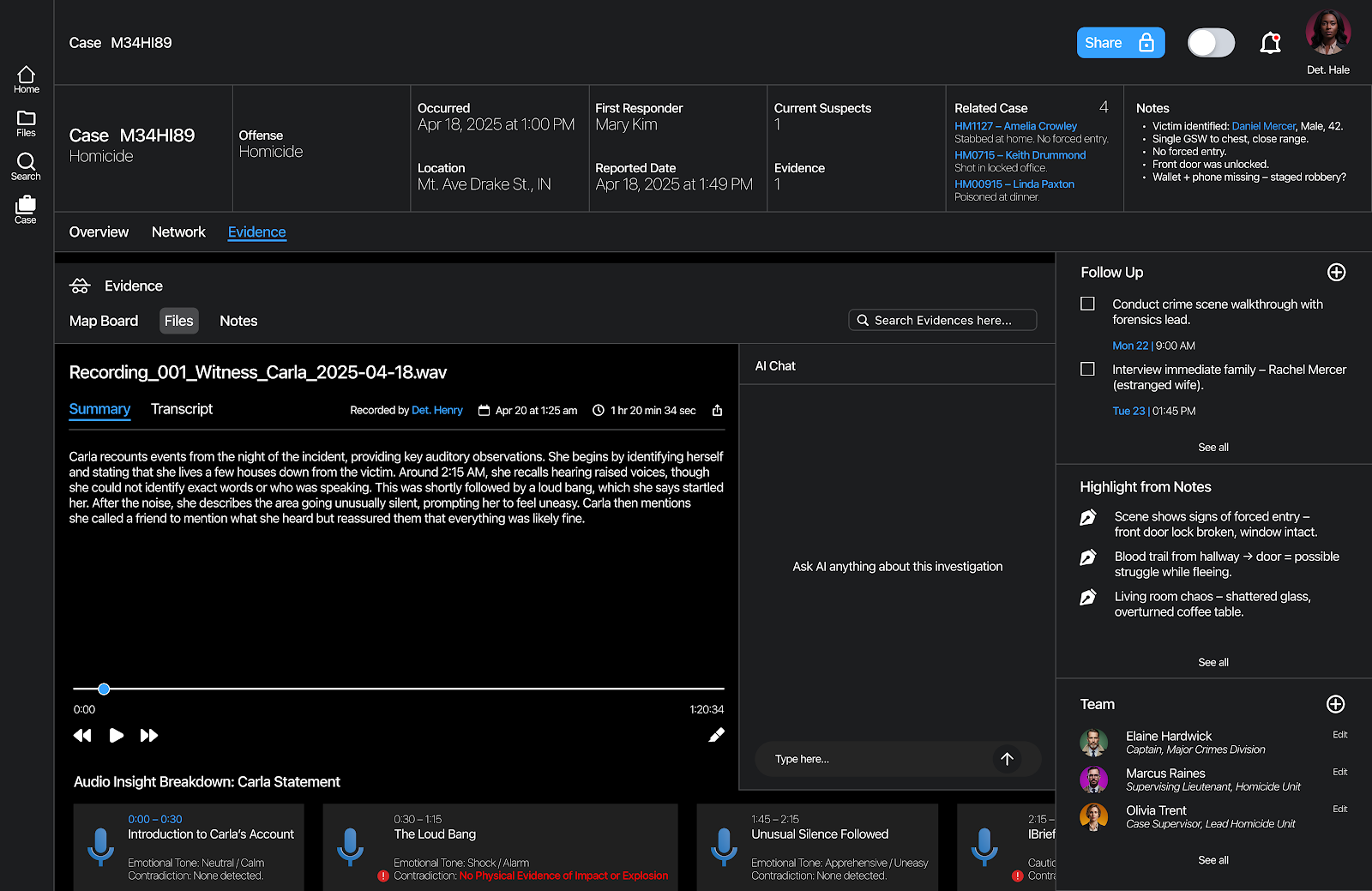
Recorded interviews transcribed in near real time with speaker diarization.
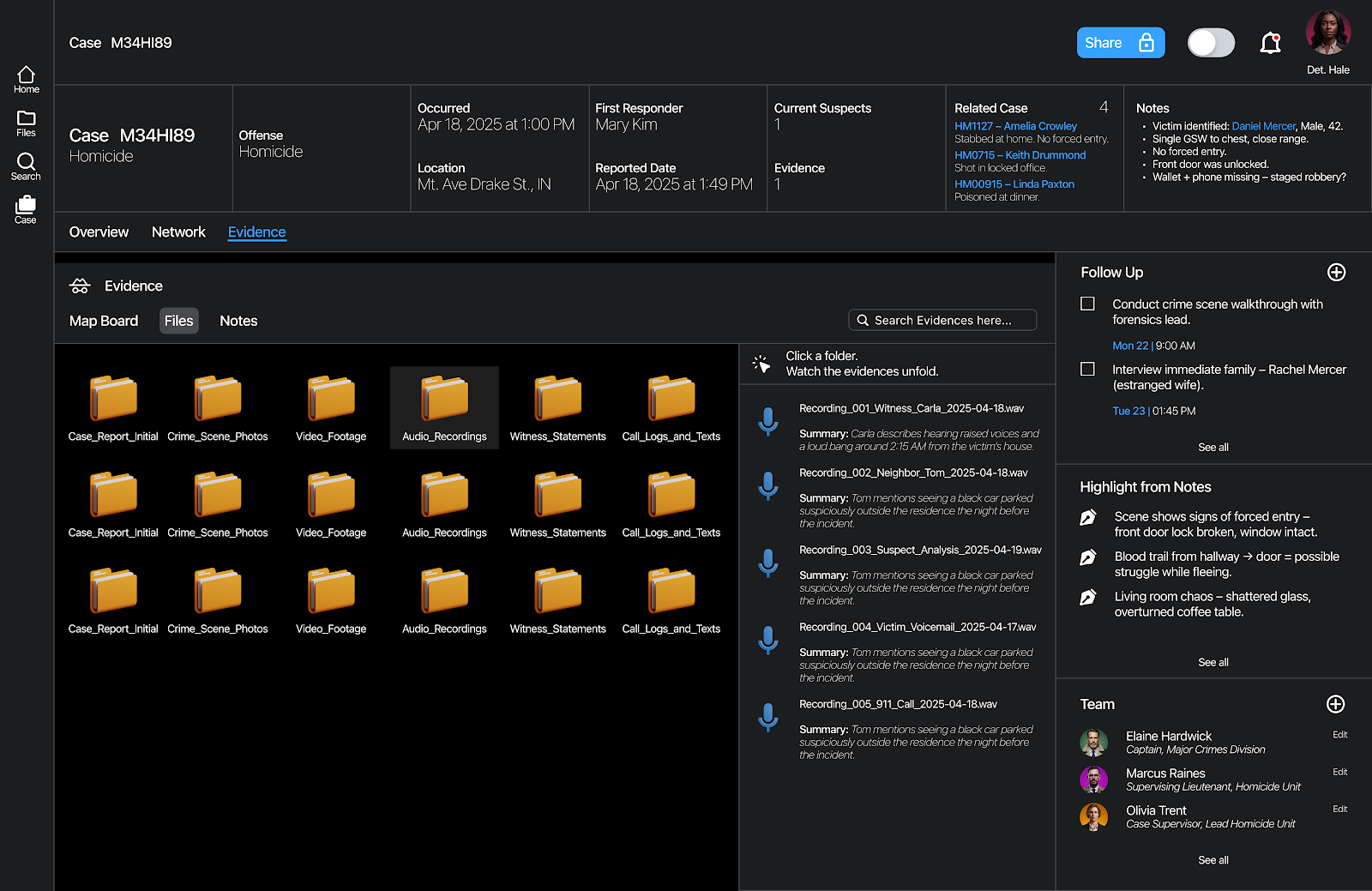
The audio selection view lets detectives jump between recordings tied to a single case.
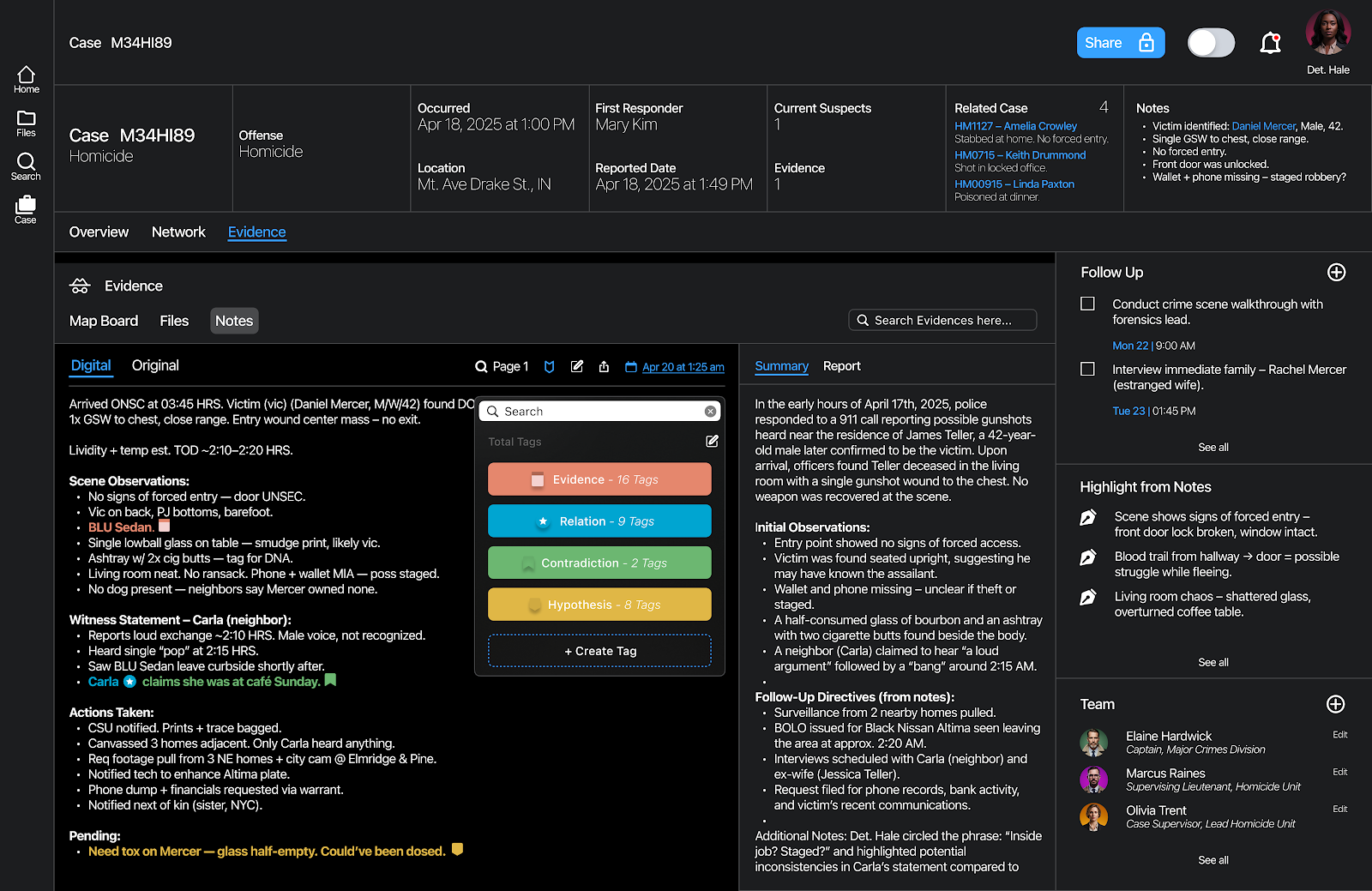
FIDO uses a structured tagging system to mark relationships between pieces of evidence.
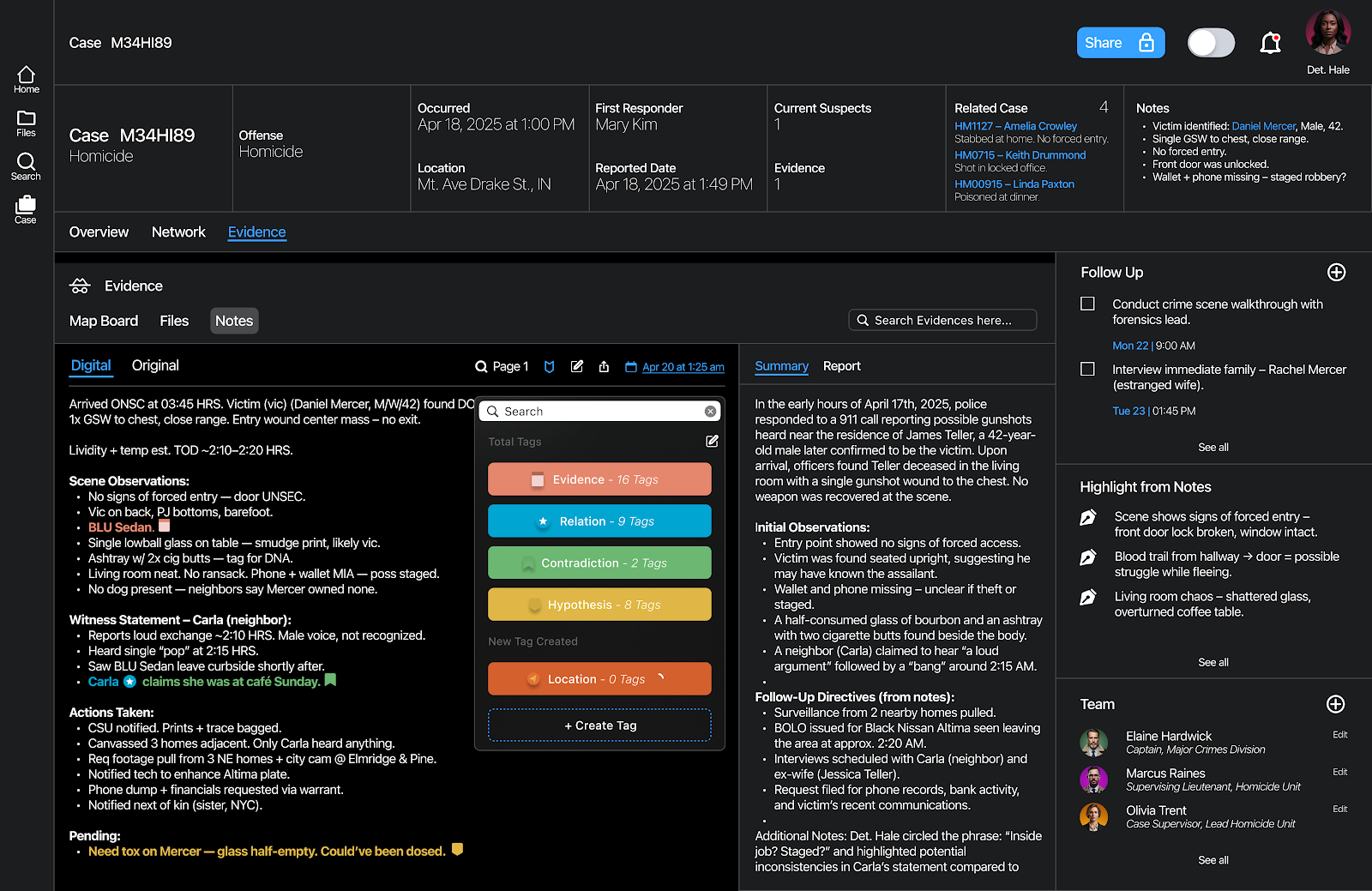
Adding a new tag to an evidence item is a single gesture.
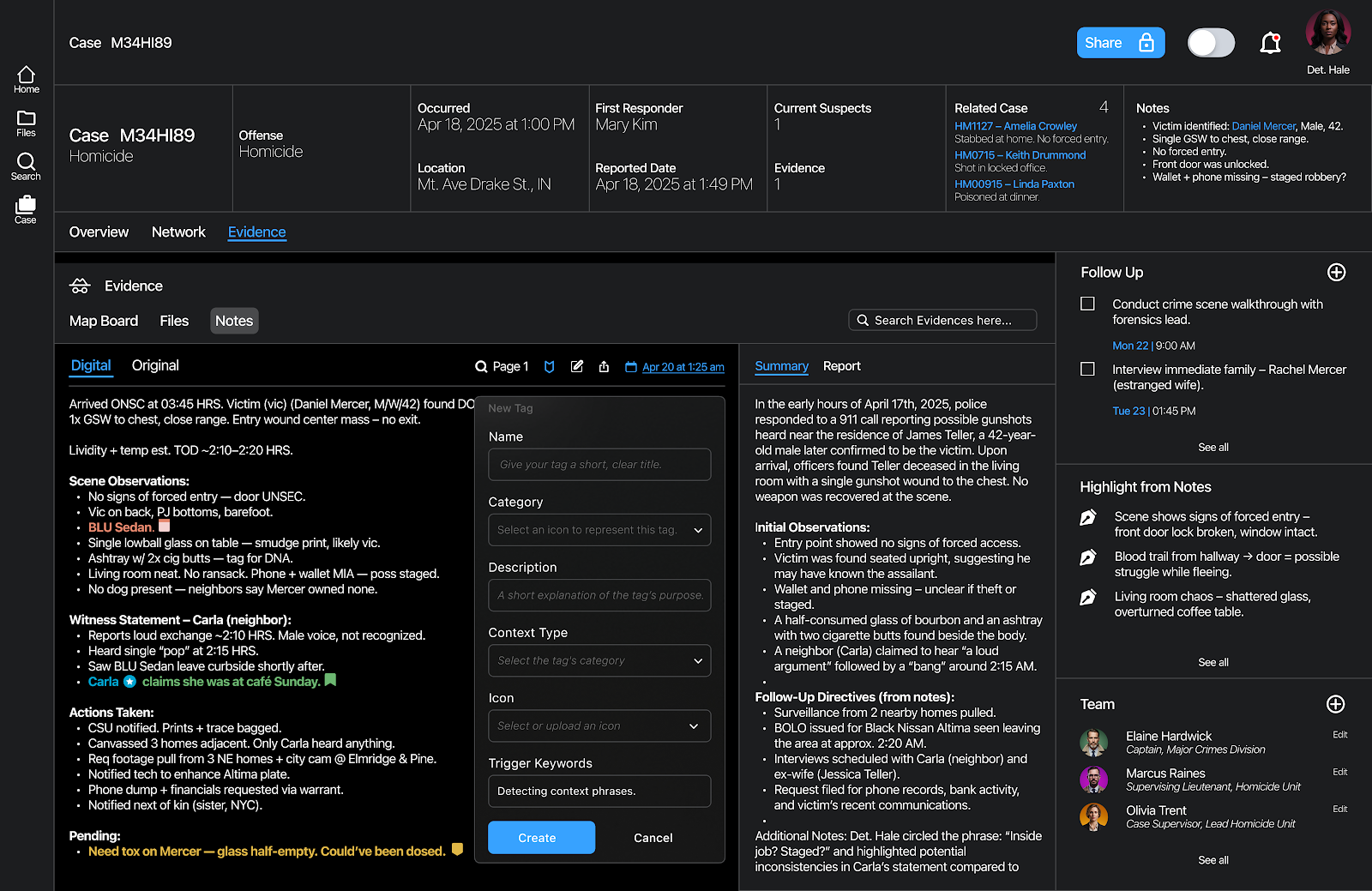
Custom tag creation lets detectives define their own taxonomy.
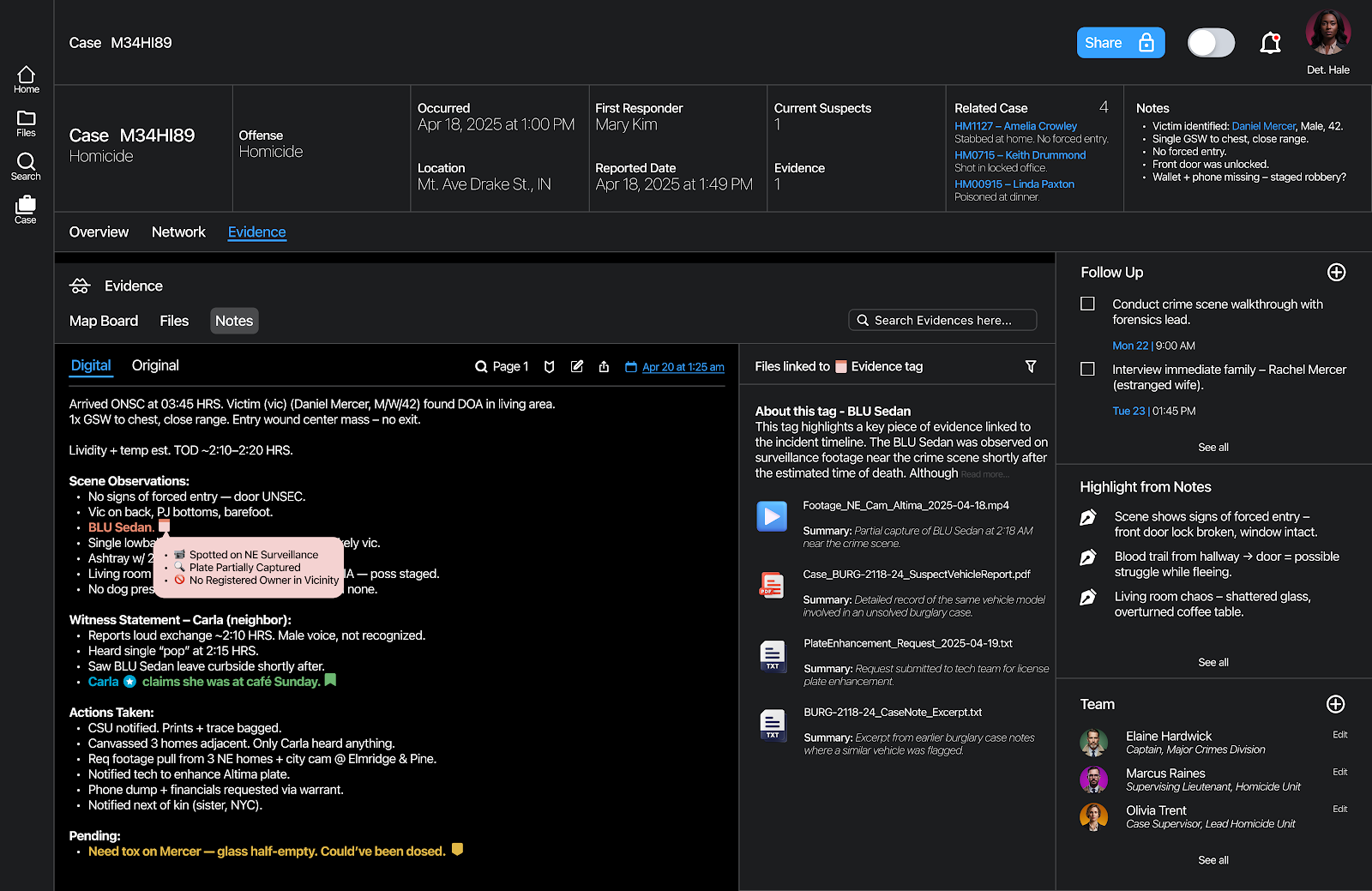
The Evidence tag links a piece of information back to a specific physical or digital exhibit.
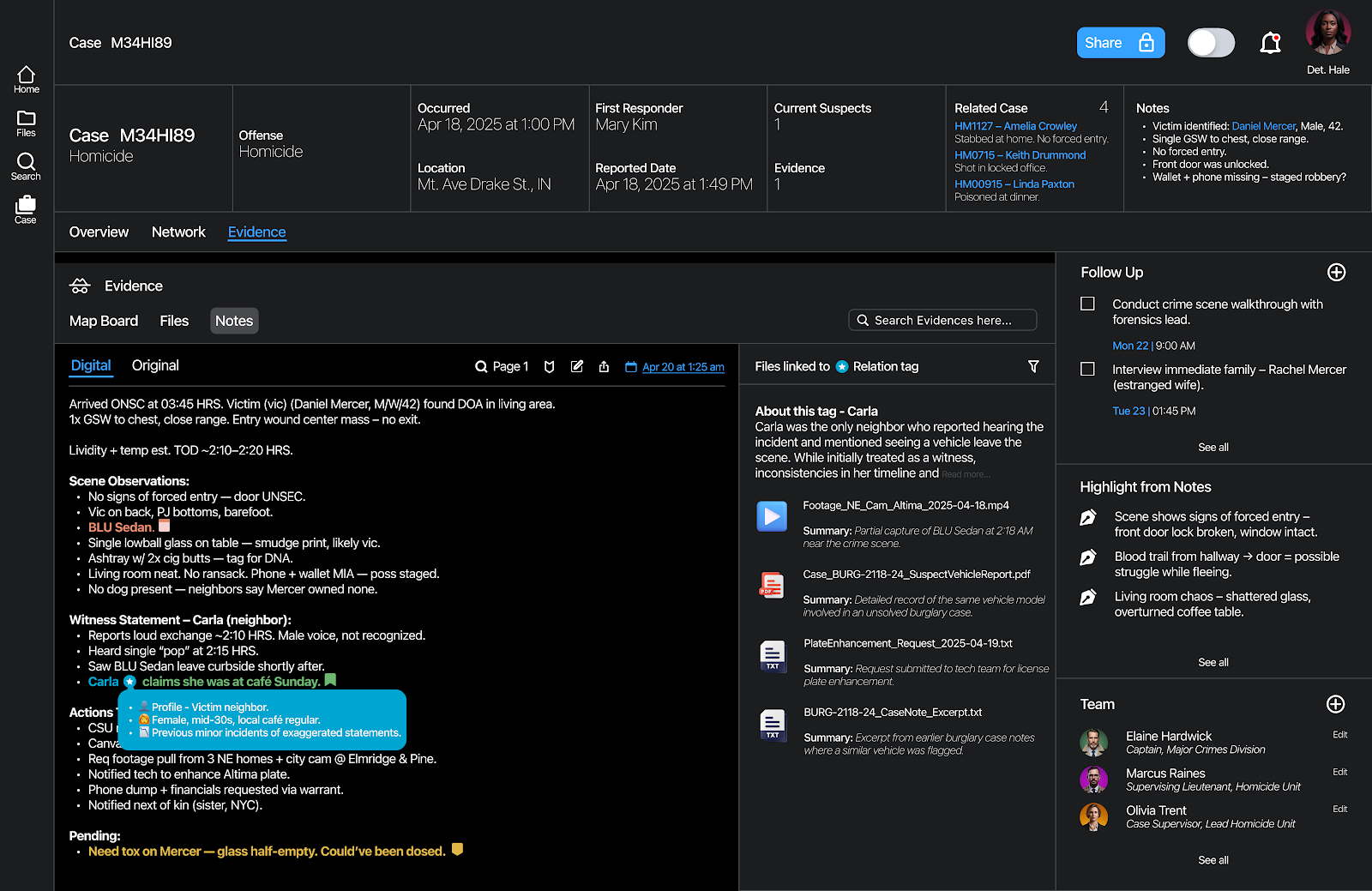
The Relation tag connects people, places, and events.
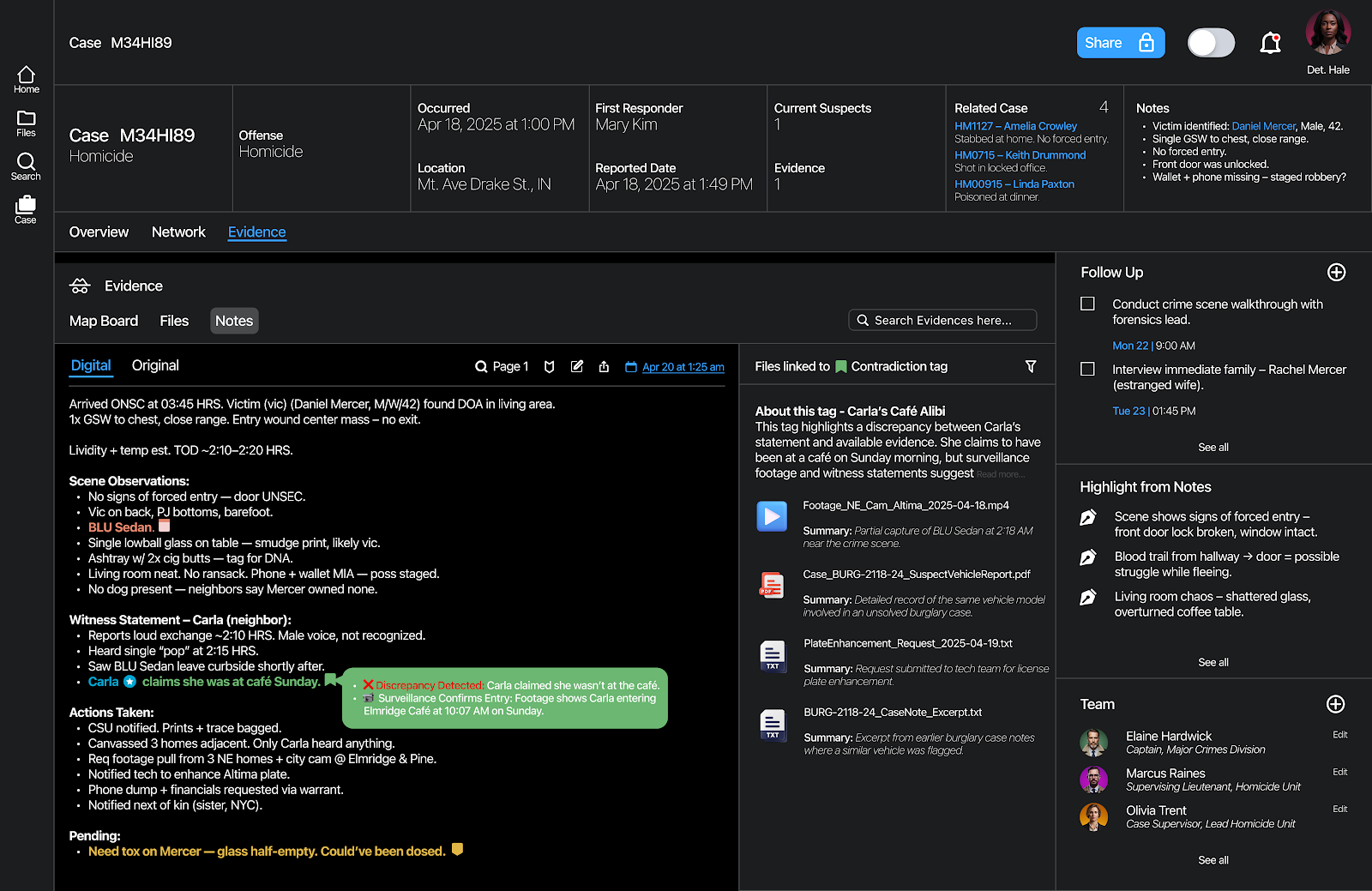
The Contradiction tag flags statements that conflict with other evidence.
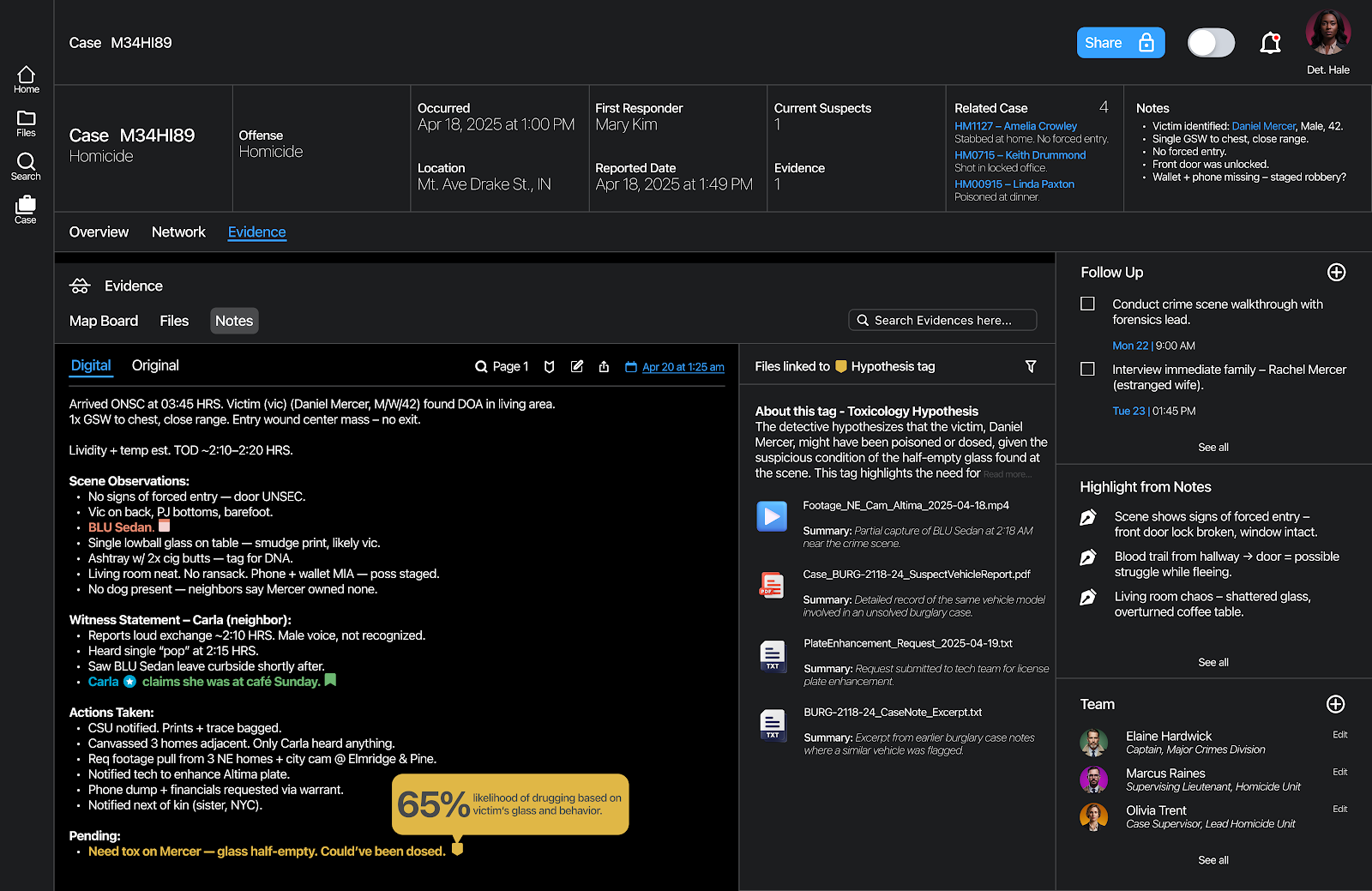
The Hypothesis tag captures a detective's working theory at a moment in time.
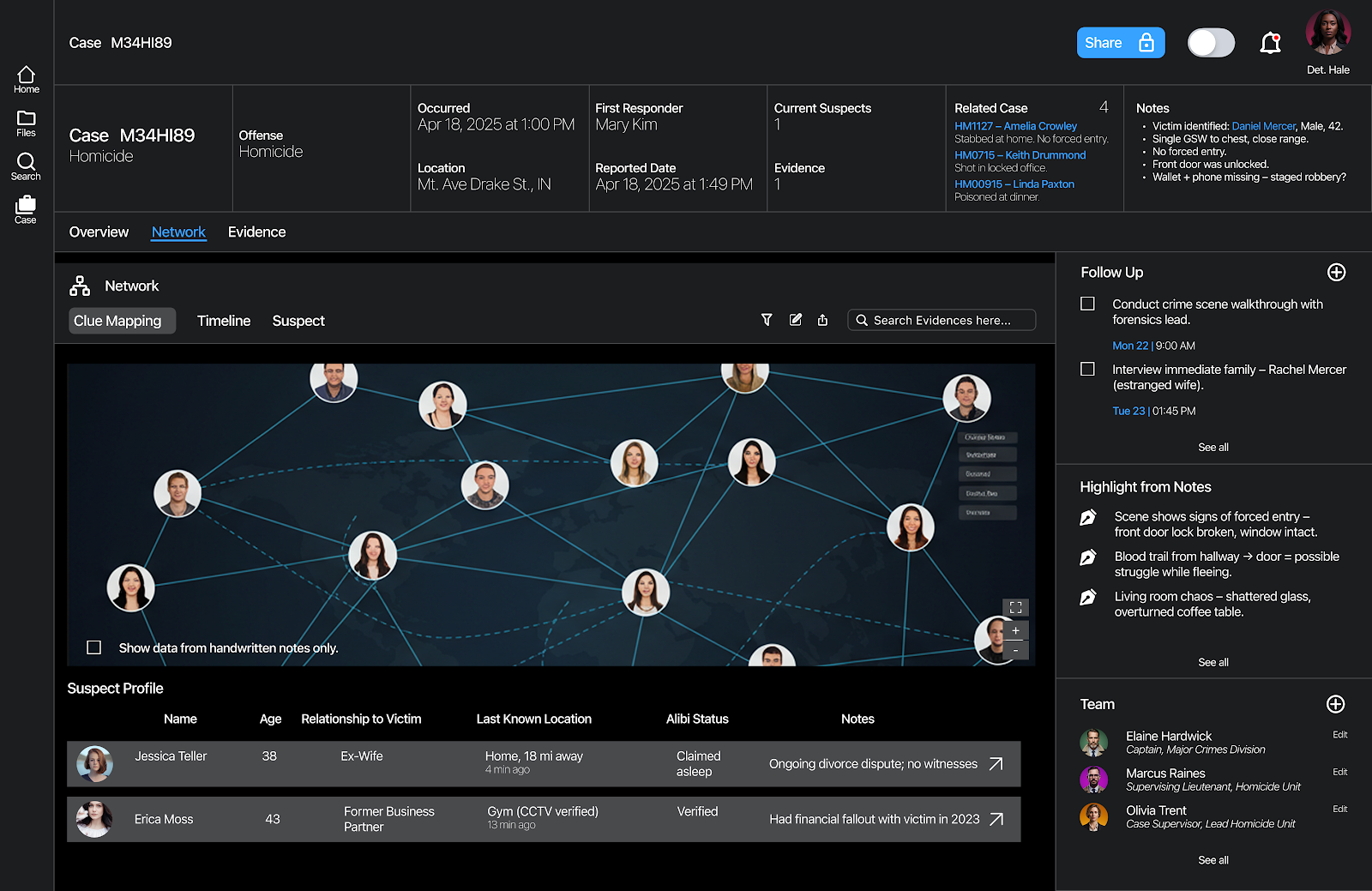
Persons, places, vehicles, and weapons appear as nodes. Edges represent co-occurrences across evidence.
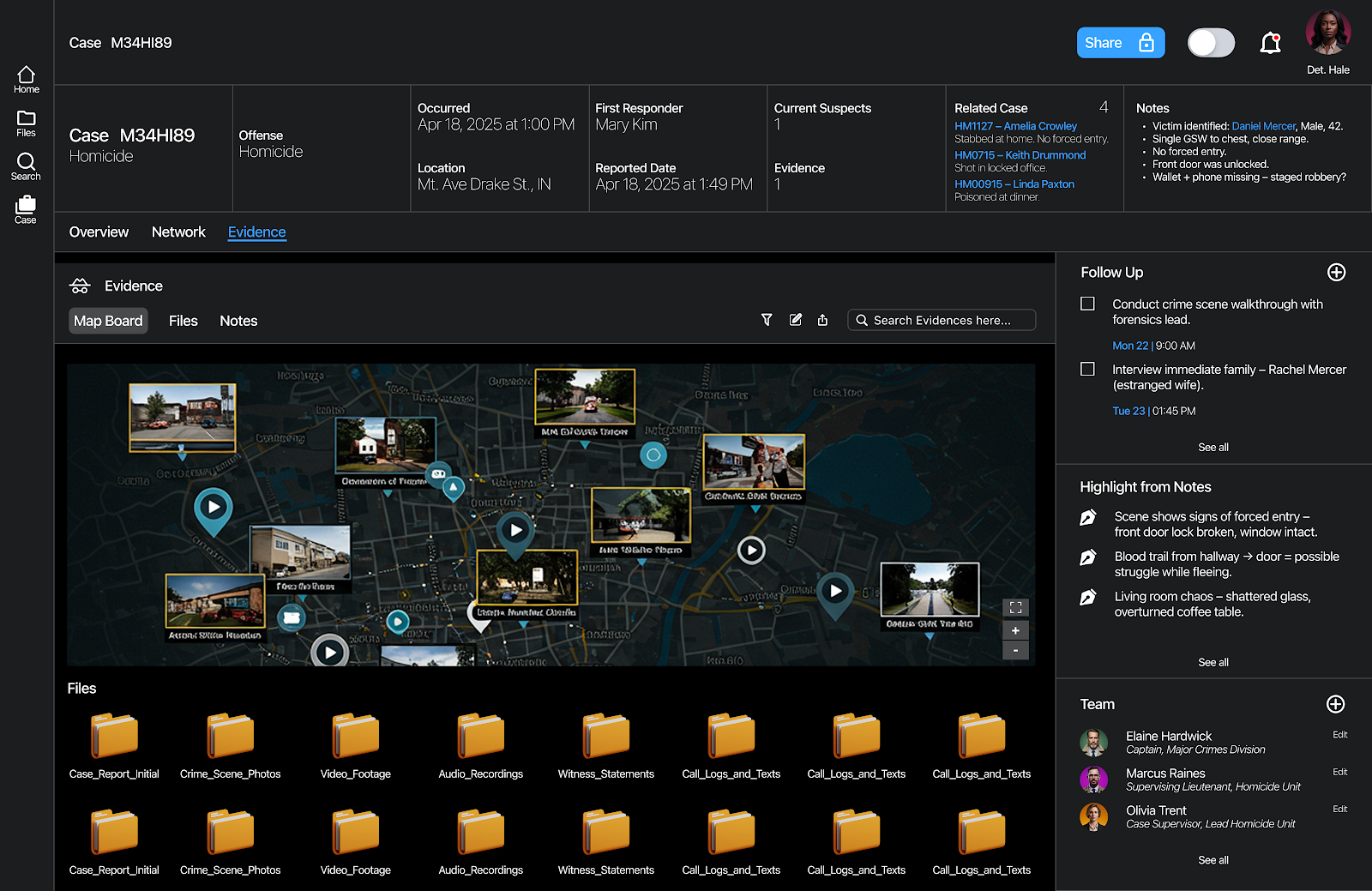
The map board overlays evidence locations on a real-world geography of the case.
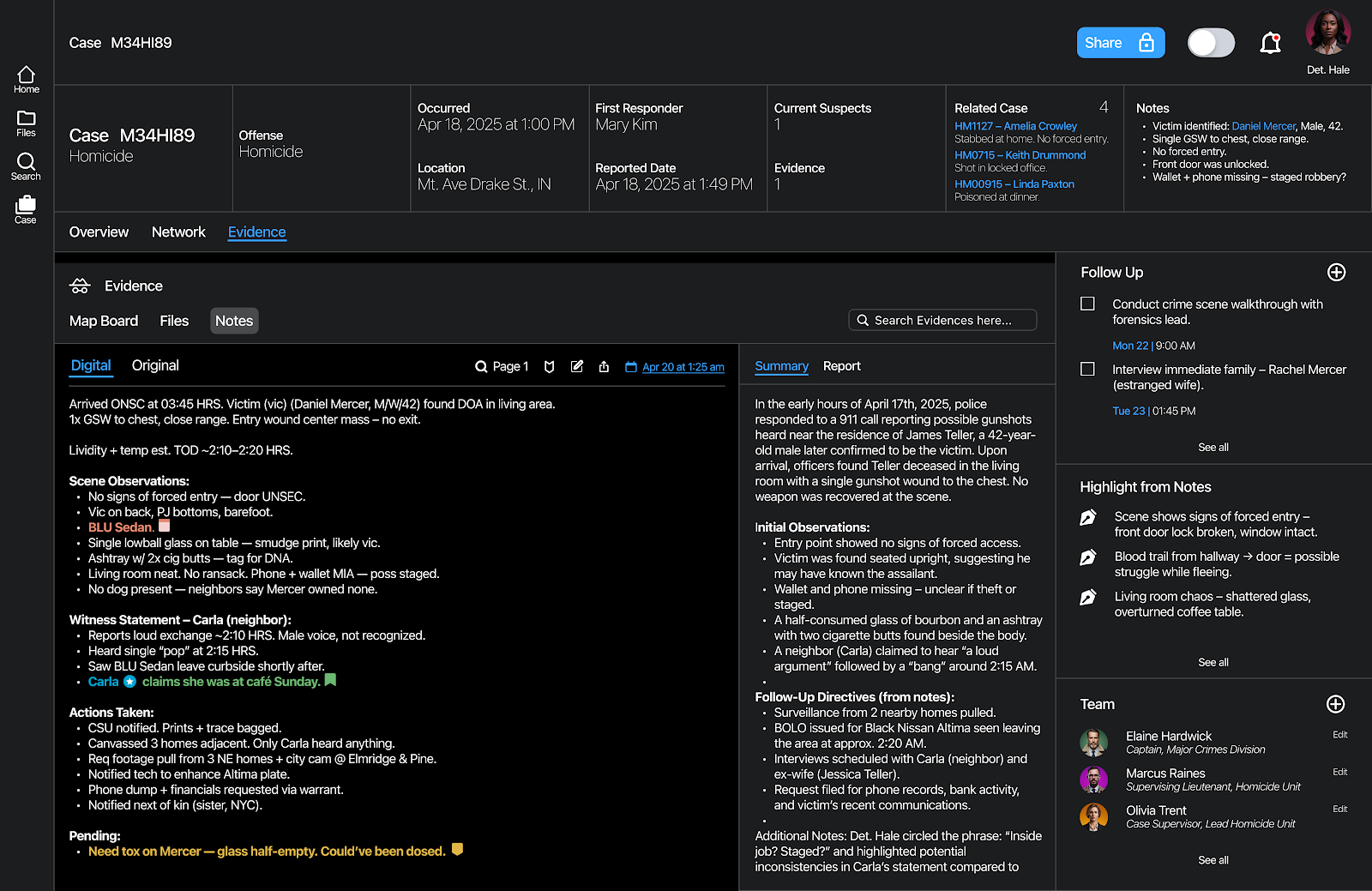
The report builder compiles all structured data into a formatted document.
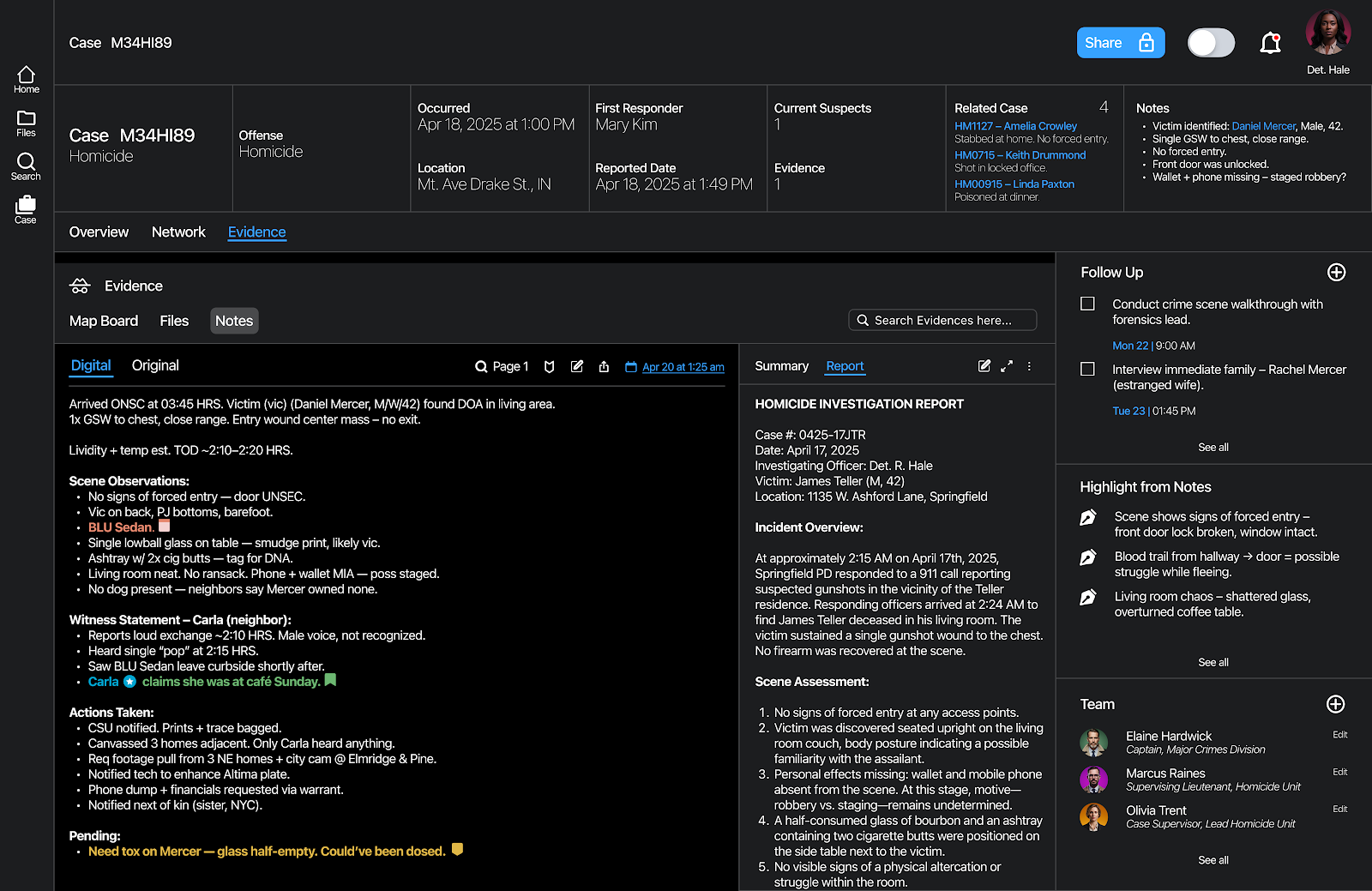
Report drafting view focused on the narrative section.
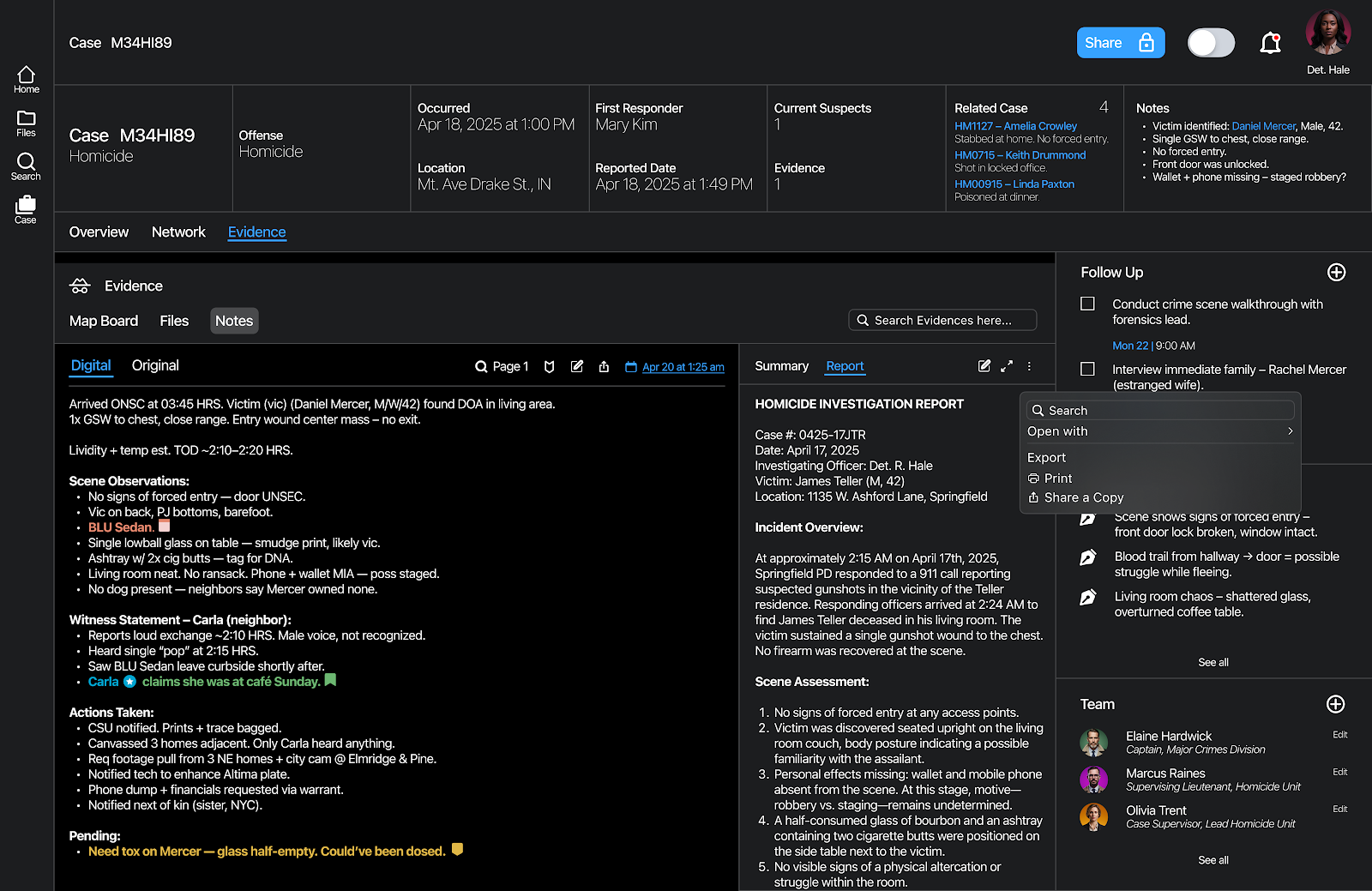
Mid-stage report view showing the integrated evidence appendix.
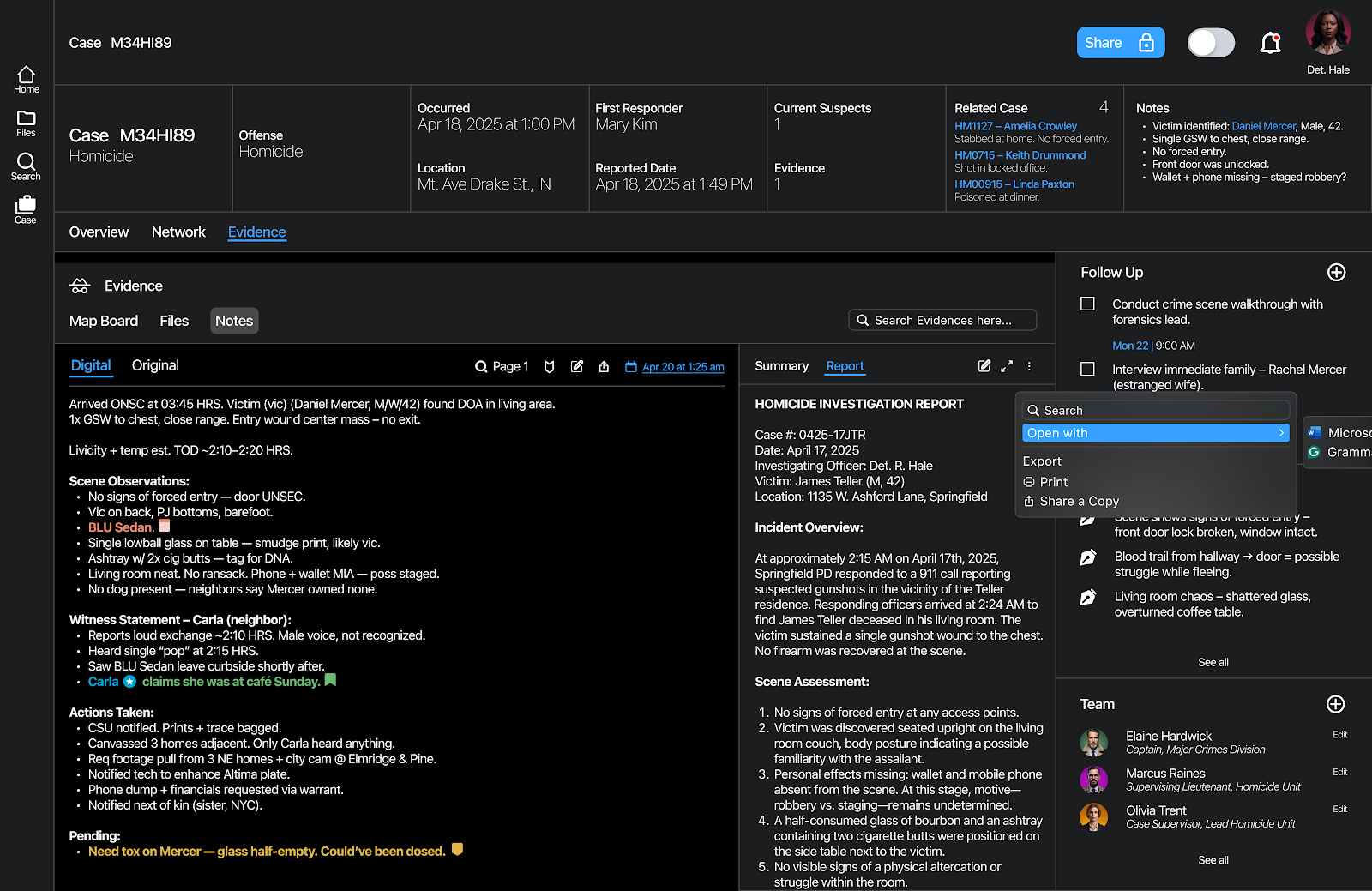
Final report view where the detective signs off on the complete document.
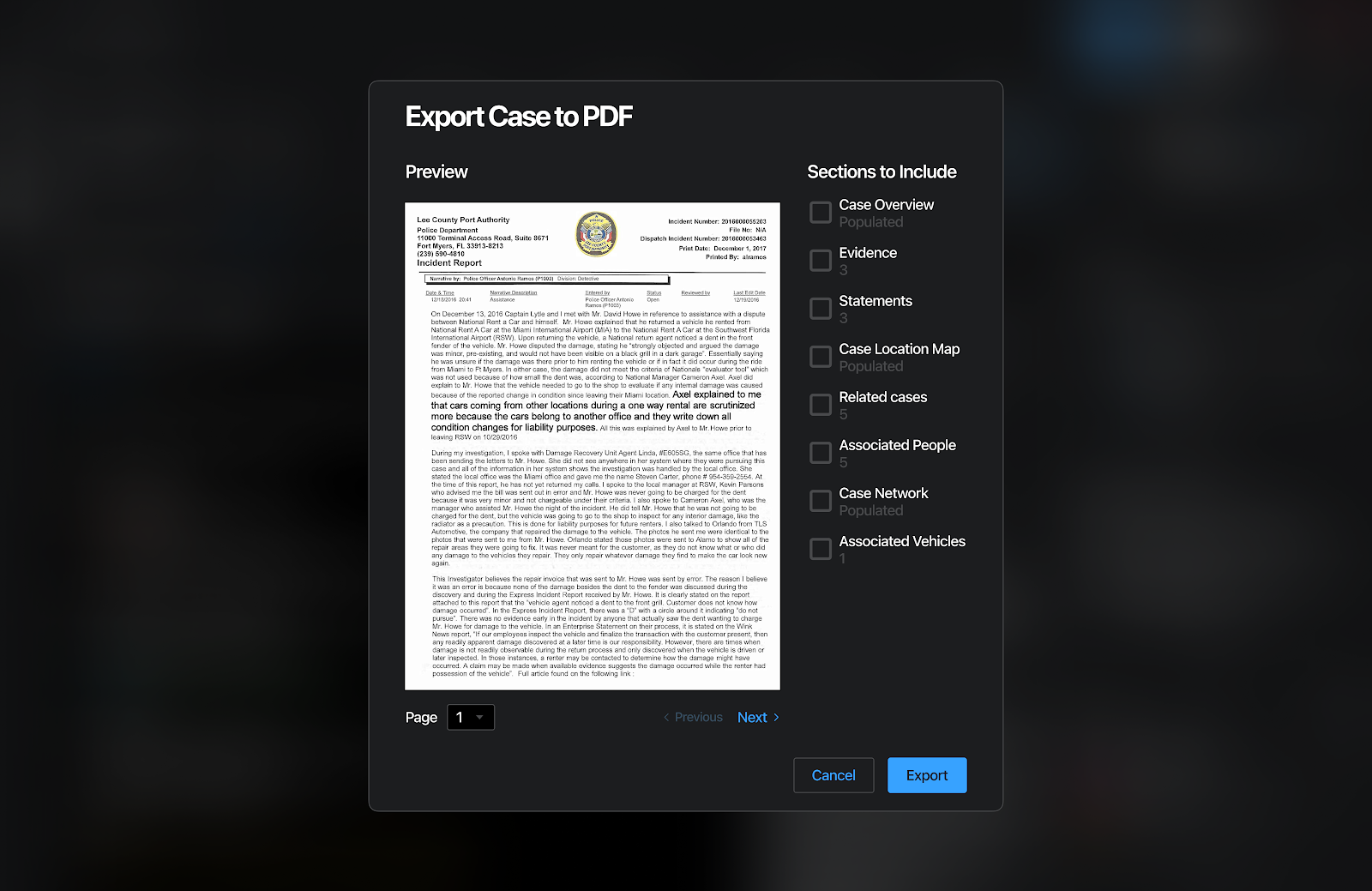
Export view supports multiple destinations including department RMS and district attorney portal.
Try It Yourself
Please Open on a Laptop for the Full Prototype Experience
The interactive Figma prototype is best experienced on a larger screen. You can still explore it directly in Figma on your phone if you'd like.
Open in Figma ↗Authenticate with your badge ID to begin the full investigator flow.
From the dashboard tap any active case to dive into the full investigation workspace.
Move between notes, audio, suspect profiles, and the relationship map to see how FIDO surfaces connections.
The 16 Week Journey
From first stakeholder interview to final presentation. Every phase builds on validated learnings.
Met with senior IMPD personnel and homicide detectives to map the current investigative workflow and identify the highest-friction moments.
Conducted recorded ride-alongs and recorded interviews from other research groups. Affinity mapping surfaced four core pain points.
Reviewed existing law enforcement tech including i2 Analyst Notebook, Cellebrite, and Palantir Gotham to identify gaps in user-centric design.
Developed the smart pen concept and storyboarded the detective journey across the critical 48-hour window.
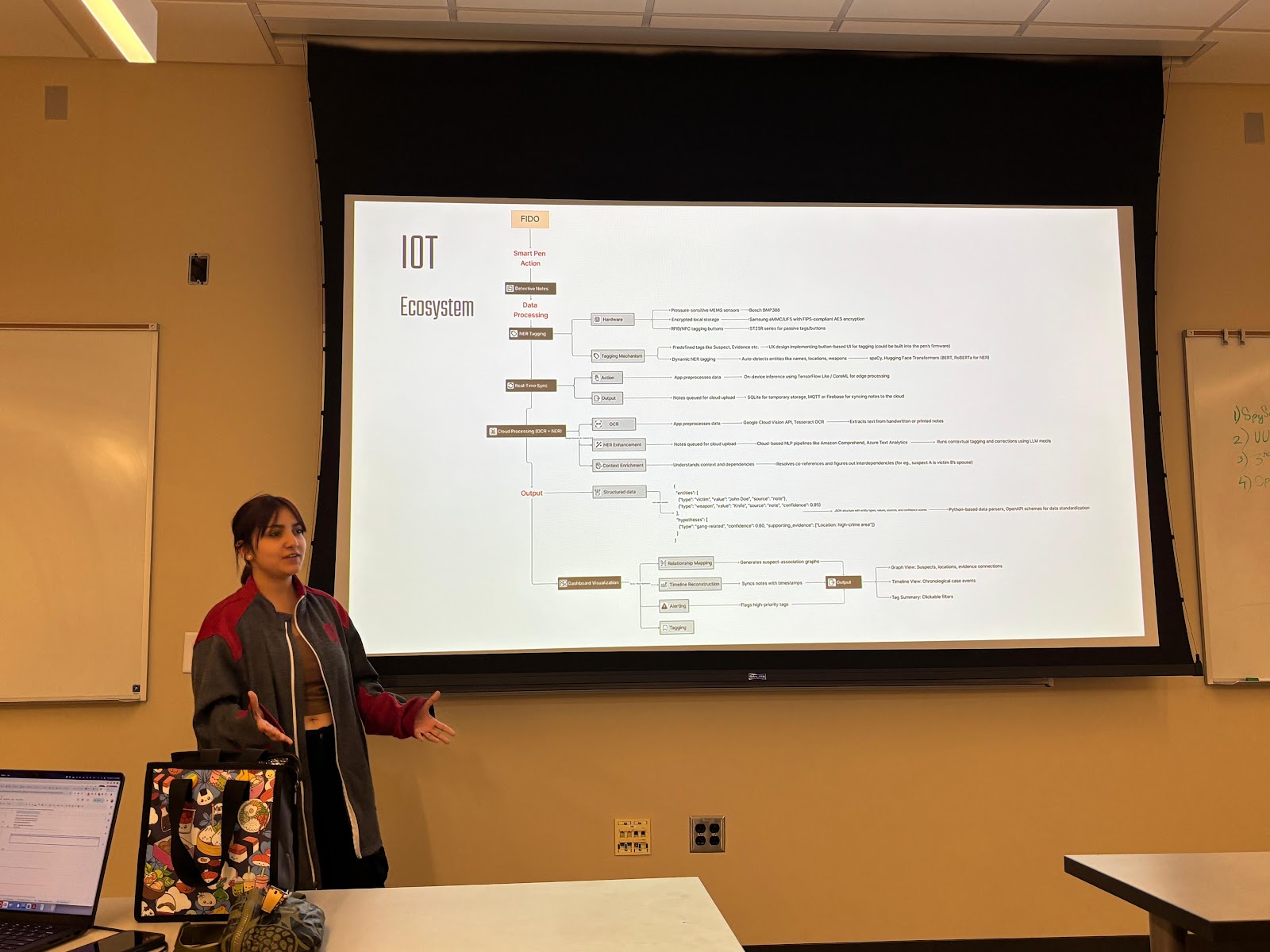
Specified the four-layer architecture from sensor input to RMS integration including the on-device preprocessing pipeline.
Modeled and 3D printed the FIDO pen and magnetic charging dock to validate ergonomics in the hands of working detectives.
Designed the full digital companion experience in Figma. Built a high-fidelity interactive prototype covering the core investigation flow.
Reviewed concept with original stakeholders and finalized the case study artifact for presentation.
How does FIDO make a difference in the first 48 hours?
Stays in sync with the detective at every step of the investigation
Reduces bottlenecks in team collaboration and evidence handoffs
Strengthens early leads before they go cold
FIDO
A smart pen system designed to transform the way detectives capture, process, and act on evidence during the critical first 48 hours of a homicide investigation.
The Case for Change
Homicide investigations fail not for lack of effort, but for lack of systems that can keep pace with the speed of field work. Detectives operate in high pressure environments where every second of delay in documentation can mean a lead going cold.
This project addresses the inefficiencies caused by manual data management and fragmented case systems. The goal was to develop intelligent tools using AI and visualization to help detectives organize information, prioritize suspects, and collaborate more effectively.
Ultimately this should lead to faster case resolution and improved closure rates in homicide units that are already stretched well beyond capacity.
The critical window in which case solving probability begins to drop sharply.
Investigative data standards FIDO draws on through global enterprise deployments.
Average time detectives spend on transcription versus active investigation work.
Defining the Core Challenge
Before any solution could be designed the team needed to understand exactly where the friction lived in a detective's daily workflow and what the stakes of that friction truly were.
How can we help detectives capture and analyze information instantly, giving them the edge in the critical first 48 hours of an investigation?
Gathering the Evidence
Interviews surfaced four key issues in current crime reporting. Hover any source badge to read the research citation behind each finding.
Deep User Understanding Is Key
This project leveraged diverse research methods including direct interviews with stakeholders and detectives, recorded interviews from other research groups, and academic papers to thoroughly understand the workflow, pain points, and specific needs of active investigators.
Significant Operational Inefficiencies Exist
Detectives currently face numerous pain points in their daily work including manual reporting, time consuming audio and video review, poor coordination due to siloed data, and overall information overload. These issues highlight a critical need for intelligent technological intervention.
Untapped Potential for AI and Data Integration
There are clear opportunities to streamline field reporting and evidence capture, enhance investigative thinking with intuitive AI, and centralize and visualize case data. This indicates a strong demand for solutions that move beyond basic data capture into intelligent analysis.
Existing Solutions Fall Short on Integration
An environmental analysis reveals that current tools including i2 Analyst Notebook, Cellebrite, and Palantir Gotham face challenges with data integration complexity, privacy concerns, implementation costs, and a lack of user centric design that works at the pace of an active investigation.
Detectives struggle converting handwritten notes, sketches, and audio into digital formats. An intelligent capture solution eliminates this bottleneck entirely without forcing a workflow change.
Detective instinct can be augmented significantly by AI driven pattern recognition and contextual entity linking that surfaces connections invisible to the human eye under pressure.
Fragmented systems and data silos prevent detectives from easily accessing and analyzing their own case information. A unified system transforms scattered inputs into investigative clarity.
Meet Detective Cruz
Detective Cruz
Homicide Investigator, IMPD
- ◆Heavy reliance on personal notes and a CAD dispatch system
- ◆Primarily works from printed case files and physical evidence boards
- ◆Coordinates with forensic labs via phone and email with no unified tracking
- ◆Spends significant evening hours catching up on transcription and reporting
A study by Michelle Wright, Department of Psychology, Manchester Metropolitan University, explores the mental process behind detective decision making.
Detectives use a combination of intuitive and analytical thinking strategies, switching between rapid pattern recognition and slower methodical reasoning depending on the stage of an investigation. FIDO is designed to support both modes, capturing the raw intuitive notes of early fieldwork while providing structured analytical tools for deeper case analysis.
The Future of Forensics
A Digital Pen Narrative
This storyboard introduces a smart pen designed to transform detective work. It traces the current inefficient manual process of note taking and transcription and shows exactly how the pen closes each gap from the very first 48 hours.
The first thing a detective does is pull out a pen and start writing. Everything they see, hear, and feel at the scene gets captured in fast, messy handwriting under pressure.
Those notes are quick sketches, half formed thoughts, and messy handwriting. This is where the case really begins, but the current tools cannot keep pace with the speed of field thinking.
Every word counts in the interrogation room. The recorder is running but every note made or missed could determine the direction of the entire case from this point forward.
The desk is cluttered and the work never stops. Transcribing audio, typing notes, and hoping for a breakthrough consumes hours that could be spent investigating instead.
Capture thoughts instantly. Transform sketches into searchable data. Sync everything to the case in real time. One tool that closes the gap between field work and digital intelligence.
Stays in sync with the detective at every step. Reduces bottlenecks in team collaboration. Strengthens early leads before they go cold and the trail disappears for good.
The pen captures handwriting, sketches, and audio simultaneously without requiring the detective to change their natural workflow.
The pen preprocesses data on device, segmenting strokes into words, symbols, and marks while filtering noise before syncing to the cloud.
All processed data pushes directly into Case Management Systems, making everything instantly searchable, shareable, and structured.
From Input to Intelligence
Data capture and preprocessing. The architecture is organized into four layers, each building on the previous to transform raw field input into structured investigative intelligence.
Input Layer
- ◆Smart pen with pressure sensors, motion tracking, and optional audio recording
- ◆Mobile companion app for syncing and supplemental data entry
- ◆Wireless magnetic charging dock with badge ID pairing
Detect stroke weight based on emphasis or urgency during note taking
Segment strokes into words and symbols, filter noise, compress for upload
Adaptive recognition across printed text, shorthand, police jargon
Named entity recognition with police specific suspect and case ID fields
Output pushed to RMS and crime mapping tools with an AI insight engine
Presenting FIDO
Named after the loyalty and precision of a trained tracking hound
FIDO is a smart pen system built specifically for the pace and pressure of homicide investigations. It combines on device AI preprocessing with seamless cloud sync, linking evidence, audio, sketches, and annotations into structured data instantly and effectively.
Automating Data Capture
As detectives write, FIDO sensors capture every stroke and nuance. It automatically records all movements, eliminating the need for manual transcription later.
Instant Digitization
The pen preprocesses data electronically, segmenting strokes into words, symbols, and marks while filtering noise and sending data to the cloud in real time.
Seamless Centralization
Processed and structured data pushes directly into existing Case Management Systems, making it instantly searchable and organized.
Optional audio capture synced to handwritten notes via timestamp alignment
Every stroke recorded the moment it lands on the page with no latency
Each detective has a personal pen profile tied to their badge ID for chain of custody
Standard ballpoint ink so field notes remain legally admissible in court
From Sketch to Form
Iterating on grip, balance, and sensor placement
Before any digital prototyping happened the design started on paper. Multiple iterations of body shape, grip diameter, and clip mechanism were sketched and reviewed against detective hand poses observed in the field interviews.
The final form factor preserves the weight and balance of a standard police issue pen so it can be used in court without any operational change for the detective holding it.
From Concept to Tangible Form
The FIDO pen was 3D printed in an aircraft grade aluminum alloy mock up to validate weight, balance, and grip ergonomics in the hands of working detectives. The physical model preserves the form factor and sensor placement of the production spec.
The Charging Dock
Dimensions 6.5 cm by 9.5 cm
The pen rolls along the angled surface and snaps into place automatically with no fumbling.
Universal connection that works with any standard police issue cable or wall adapter.
The dock clips onto the back of any standard field notepad for convenient portability during long hours.
Each dock is laser engraved with the assigned detective name to prevent mix ups across the squad room.
The Digital Companion
The FIDO pen feeds into a full digital companion built for case management. Twenty two screens cover the full investigator workflow, organized into six functional groups. Filter by group or click any screen to inspect it in detail.
Try It Yourself
Click anywhere on the prototype below to walk through the full FIDO investigator flow. Open in Figma for full screen control and to see the underlying design system.
Authenticate with your badge ID to begin. The starting screen of the prototype walks through detective access.
From the dashboard tap any active case to dive into the full investigation workspace.
Move between notes, audio, suspect profiles, and the relationship map to see how FIDO surfaces connections.
The 16 Week Journey
From first stakeholder interview to final presentation and delivery. Every phase builds on validated learnings from the previous one.
Met with senior IMPD personnel and homicide detectives to map the current investigative workflow and identify the highest friction moments.
Conducted recorded ride alongs and recorded interviews from other research groups. Affinity mapping surfaced four core pain points.
Reviewed existing law enforcement tech including i2 Analyst Notebook, Cellebrite, and Palantir Gotham to identify gaps in user centric design.
Developed the smart pen concept and storyboarded the detective journey across the critical 48 hour window.
Specified the four layer architecture from sensor input to RMS integration including the on device preprocessing pipeline.
Modeled and 3D printed the FIDO pen and magnetic charging dock to validate ergonomics in the hands of working detectives.
Designed the full digital companion experience in Figma. Built a high fidelity interactive prototype covering the core investigation flow.
Reviewed concept with original stakeholders and finalized the case study artifact for presentation.
How does FIDO make a difference in the first 48 hours?
Stays in sync with the detective at every step of the investigation
Reduces bottlenecks in team collaboration and evidence handoffs
Strengthens early leads before they go cold